John Quincy Adams Quotes
He is a slave-monger whose talents are not above mediocrity, and with a spirit incapable of expansion to the dimensions of the station upon which he has been cast by the hand of Providence
After his Presidency, Adams served in the House of Representatives for many years and was thus active in politics.
John Quincy Adams, 1767-1848, 6th President of the United States (Independent, MA), Opinion of President John Tyler
Sourced by: Eigen's Political and Historical Quotations

Menander first originated the phrase. However, Julius Caesar made it famous, by stating it when he crossed the Rubicon River with his Legions and headed for Rome. He had passed the “point of no return.” It was forbidden for a Roman commander of legions to allow the legions under arms to come that close to Rome under the theory that no military commander could take over the government if his legions were at a distance from Rome. Caesar was indeed marching on Rome with his troops, and took over the government. The great phrase implied that the key action had been taken and the commitment made. The dice was thrown but no one know yet what the results would be. For Caesar, they turned out to be good. Dice was a very good metaphor for the era as Greek and Roman men played (and gambled) on dice games frequently. John Adams used a variant of the quotation in castigating President Taylor. See {622034}


Indian and Black slaves were outlawed very early in Connecticut, not on moral grounds of concern for the Indians and Blacks, but because of the negative effects on the white poor. Why would anyone pay the poor any more than the amortization costs of a slave? Therefore there was no way a poor white could make a living wage if slavery were to coexist.


The cotton industry and slavery were a very important part of the economy of Providence, RI. The Rhode Island cotton mills were supplied by Southern cotton produced by slaves and carried from the South on Rhode Island ships. Many of the southern slaves were kidnapped from Africa from Rhode Island slave trading ships. When the slave trade was made illegal, Brown was the first slave trader prosecuted. His brother, Moses Brown, a vehement abolitionist was one of the men who brought the prosecution.

Samuel Langhorne Clemens, 1835-1910


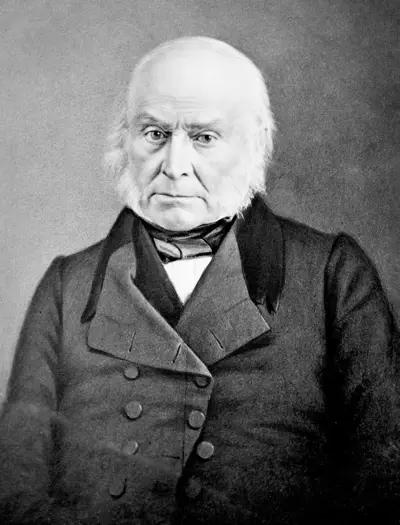
- Born: July 11, 1767
- Died: February 23, 1848
- Nationality: American
- Profession: President
John Quincy Adams was an American statesman, diplomat, lawyer, and diarist who served as the sixth president of the United States, from 1825 to 1829. He previously served as the eighth United States Secretary of State from 1817 to 1825. During his long diplomatic and political career, Adams also served as an ambassador, and as a member of the United States Senate and House of Representatives representing Massachusetts. He was the eldest son of John Adams, who served as the second U.S. president from 1797 to 1801, and First Lady Abigail Adams. Initially a Federalist like his father, he won election to the presidency as a member of the Democratic-Republican Party, and in the mid-1830s became affiliated with the Whig Party.
