Roman Empire Quotes
Those who pasture on the common pastures larger animals of no greater number than ten plus their offspring up to one year of age ... shall not owe any tax or fee for these animals ... to the State or to any tax farmer nor give security nor pay anything for this reason.
This is one of the earliest codifications of grazing rights. Note that the free grazing privilege only applied to small herds. For more than 10 adult animals there were fees. The issue of grazing rights and fees is still debated. The principle was extended to smaller animals such as sheep and goats, but the maximums increased.
Ancient Rome, Agrarian Law, 111 B.C.
Sourced by: Eigen's Political and Historical Quotations

The Bedouin live by their flocks without which they have little material existence.

The notion that public lands should be available for the grazing of private herds of animals is very old. Note that the Roman law expressly forbade the collection of fees for grazing rights. The reasoning was that virtually all free Romans had animals that needed grazing and pasture land. So all citizens could take advantage of the public facility. As society became more industrialized and specialized, the percentage of citizens who could benefit reduced over time until there became less than 1 percent of citizens who could benefit from a asset that was paid for and maintained by all citizens. Then there was a rationale for charging user fees.


[If a business takes other investors in to finance its growth or expansion, there are no tax consequences with the equity investment. However, if the same business borrows money from a bank, the business can deduct the interest cost of the debt from their federal and usually state taxes. If an individual buys a house and takes a large mortgage, the owner can deduct the interest from his taxes. However, if she instead does the more prudent and safe thing and puts more cash equity and takes a smaller mortgage, she only gets a small tax deduction.]

The very rich told the middle class that if the rich had to pay taxes there would be little money left to operate factories and buy luxuries that employed middle class merchants and artisans. Many believed the argument and were willing to pay taxes even though the richest people did not. Gogel held the line however, and the desperate need for war financing for Napoleon Bonaparte Bonaparte’s conquests caused the King to tax even the rich.

Ford had asked Iacocca, then the President and the number 2 executive to Ford, if he paid any income tax. Iacocca paid about 50 percent of his income as the maximum bracket at the time was over 70 percent. Ford wanted to help him out. At the time Ford earned millions of dollars every month. One of the things that this quote illustrates is that it would not have mattered with Ford whether the maximum tax rate was 30%, 50% or 70%. He and the other super-rich people were not going to pay much anyway because of the loopholes, the deductions, and gaming the system.


Under the American tax codes, religions and other nonprofit organizations have been exempt from paying taxes of all kinds. The “Bible Belt” is a region in the South where there are many churches and a very high percentage of religious people and especially Christian Fundamentalists.

He was referring to a religious requirement in the Koran that Muslims spend 10 percent of their wealth in helping the poor. However, the nation had huge oil revenues and virtually every government purchase and license involved kickbacks and “commissions” to someone—typically a member of the Royal Family or their cronies. See {627158}.

This is the basis for the difference between tax evasion which is illegal and tax avoidance which is legal—made so by this Supreme Court decision.


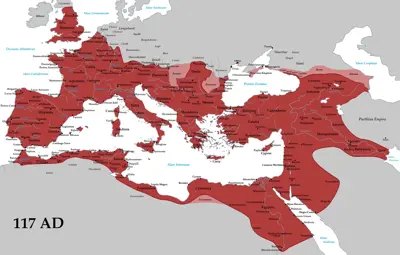
The Roman Empire (Latin: Imperium Romanum [ɪmˈpɛri.ũː roːˈmaːnũː]; Koinē Greek: Βασιλεία τῶν Ῥωμαίων, romanized: Basileía tōn Rhōmaíōn) was the post-Republican period of ancient Rome. As a polity it included large territorial holdings around the Mediterranean Sea in Europe, Northern Africa, and Western Asia ruled by emperors. From the accession of Caesar Augustus to the military anarchy of the 3rd century, it was a principate with Italy as metropole of the provinces and the city of Rome as sole capital (27 BC – AD 286). After the military crisis, the empire was ruled by multiple emperors who shared rule over the Western Roman Empire and over the Eastern Roman Empire (also known as the Byzantine Empire). Rome remained the nominal capital of both parts until AD 476, when the imperial insignia were sent to Constantinople, following the capture of Ravenna by the barbarians of Odoacer and the subsequent deposition of Romulus Augustulus. The adoption of Christianity as the state church of the Roman Empire in AD 380 and the fall of the Western Roman Empire to Germanic kings conventionally marks the end of Classical antiquity and the beginning of the Middle Ages. Those events, along with the gradual hellenization of the Eastern Roman Empire is why historians distinguish the medieval Roman Empire that remained in the Eastern provinces as the Byzantine Empire.
