Bandar Bin Sultan Quotes
We have a no taxes. We have a religious tax that is non-enforceable.
He was referring to a religious requirement in the Koran that Muslims spend 10 percent of their wealth in helping the poor. However, the nation had huge oil revenues and virtually every government purchase and license involved kickbacks and “commissions” to someone—typically a member of the Royal Family or their cronies. See {627158}.
Bandar Bin Sultan, Saudi Arabian Ambassador to the United States, Response when questioned about the immense corruption in Saudi Arabia, PBS Frontline: Saudi Arabia, February 8, 2005
Sourced by: Eigen's Political and Historical Quotations

He observed that Saudi Arabia was the only oil rich country that at least modernized itself in spite of the amount wasted on corruption. Bandar’s point was that the bribes enabled the country to transform itself and without the bribes, modernization would have been impossible as in other oil counties.


At the time Rangel was the Chairman of the House Ways & Means Committee which had jurisdiction over tax matters.

“Zakat” is the practice of giving a percentage of one’s property to the poor. This is similar to the concept of tithing and charity in Christianity and Judaism. One difference today is that many of the Muslim nations use the religious requirements as an element of state policy and the social safety net is intertwined by state and church. The Mormon Church in early Utah had the same amalgam of church and state, but that was abandoned in favor of separation of church and state. Turkey went through the same shift in the Ataturk revolution.

Under the American tax codes, religions and other nonprofit organizations have been exempt from paying taxes of all kinds. The “Bible Belt” is a region in the South where there are many churches and a very high percentage of religious people and especially Christian Fundamentalists.
In Ireland at the time the established church—the Protestant Anglican Church of Ireland—had the legal right to collect annual Tithes from the population in order to fund the activities of the Church. One difficulty however, was that the majority of the population were Roman Catholics. The poorest of them could not afford the tithe payments to any church. Whereas in the past, the Protestant Church officials did not force the issue of tithe collection from the poor, in about 1830 they changed and seized the property of the poor (Protestants and Catholics) and auctioned it off to pay for the tithe. The Cardinal organized a campaign of non-violent civil disobedience to combat the Tithe. See {639227}.


In this particular injunction the Queen actually proscribes the amount of church revenues that MUST be distributed to the poor. See {617526} where actual prayers are proscribed by the government.


Head of the Sikh Religion. He was the first Sikh Guru to utilize weapons,
The Manual was found by the Manchester (England) Metropolitan Police during a search of an Al Qaida member's home. In Islam there is virtually no difference between religion and civil life.


This was one of the principles of Saxon King Alfred in his distribution of 1/4 of his revenue. Typically. Kings would give lands, monies and tax exemptions to the wealthy nobles to ensure their support and loyalty even though they did not need the benefit, and those that needed, did not get. Opponents of George W. Bush and the early 21st century Republicans used this quotation to criticize the policies that would be large tax cuts and other benefits to the wealthy, while assuming that there would be a “trickle down” effect to the others.


This was a swipe at the Conservatives at the time who were opposed to a Federal Government that would actively provide assistance directly to individuals. There was a belief amongst some politicians that by assisting people in need, their character would be weakened and the people and the society would be hurt in the long run.


The quotation is from Walzer, but the idea was originated by the Jewish Rabbi, Physician and Philosopher Maimonides (1135-1204) who Walzer credits. This idea is really at the historical and philosophical backbone of all welfare reform efforts. Maimonodes, for example, argued that one of the greatest forms of charity is giving a person money or other assistance to start a business.

This is only one of many anti-American and anti-Israeli and anti-Semitic passages in the text. It is typical of much of the Wahhabi literature which also supports jihad and violence. Much of the funding for the Wahabbi comes from the Saudi Arabian Government and members of the Saudi Royal Family. There is total censorship in Saudi Arabia and nothing gets preached or printed if the Saudi government wishes otherwise. However, most of the imams in Saudi Arabia are Wahhabi and are paid by the government. The Royal Family’s only fear of losing power is if the Islamic clerics claim that the government is not supportive of Islam. They spend much money to buy their lack of opposition to the monarchy. The government position however is contrary to these hate-filled textbooks.

This quotation is one of the earliest social safety nets. It is also one of the strictures of Jesus, to which most Christian communities have not strongly adhered. It is the religious foundation for welfare.

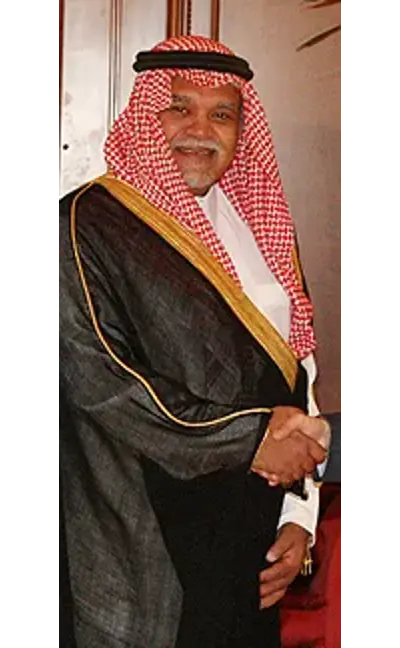
- Born: March 2, 1949
- Nationality:
- Profession:
Bandar bin Sultan Al Saud is a member of the House of Saud and was Saudi Arabia's ambassador to the United States from 1983 to 2005. From 2005 to 29 January 2015 he served as secretary general of the National Security Council, and was director general of the Saudi Intelligence Agency from 2012 to 2014. On 1 July 2014 he was appointed King Abdullah's special envoy which lasted until 29 January 2015.
