Solomon Northup Quotes
They are deceived who flatter themselves that the ignorant and debased slave has no conception of the magnitude of his wrongs. They are deceived who imagine that he arises from his knees with back lacerated and bleeding, cherishing only a spirit of meekness and forgiveness. A day may come - it will, if his prayer is heard. A terrible day of vengeance when the master in his turn will cry in vain for mercy.
Northup, Solomon. Twelve Years a Slave. Derby and Miller, 1853, p. 249.

While many of the Indian wars were over land or were defensive in nature, the major motivation for some wars with Indians was pure greed in that captured Indians were sold as slaves.

A Cossack revolt had broken out in 1707 and was put down by the Czar’s forces. He then issued what might be one of the first official orders for genocide. Few Cossacks survived.


The Sally was owned by Nicholas Brown and Company and this voyage was financially unsuccessful with 109 out of 196 slaves dying in board. Brown, of the family that founded Brown University, was discouraged by this voyage and withdrew from the slave trading business. See {641475}. American naval hero, John Paul Jones, served under Hopkins in the American Revolution.

The point about the negroes who were born into American slavery being less aggressive than those captured and transported to America is often overlooked. Slavery not only was cruel, moral, and inhuman in its own right, but also took its toll over generations as a result of the psychological effects of the terror of slavery. Despite these, it is amazing how resiliant the American Blacks were under those circumstances. in some cases one or two saves escaped after committing a violent act as they had little to lose for trying as they wold be killed if caught. A few of these escaped to the North and others reached Southern Cities like Charleston where there was a small free black community in which they could be absorbed.


In Russia at the time, serfs were little better off than slaves. Not only did they have to obey their landlords in all things, but any who advocated disobedience on their part were beaten and sent to Siberia. Exile to the Siberian Gulags was not an invention of the Communists of the 20th century although they used that punishment in unprecedented numbers. It was used by the Czars and the Empress.
As a British Loyalist officer, he and his men were dispatched to Savannah, Georgia. There he saw the Southern version of slavery for the first time and was shocked at the cruelty. At the end of the Revolutionary war, he and many other loyalists fled to Canada and began his political career, then representing Britain in the Caribbean. See also {591379}.

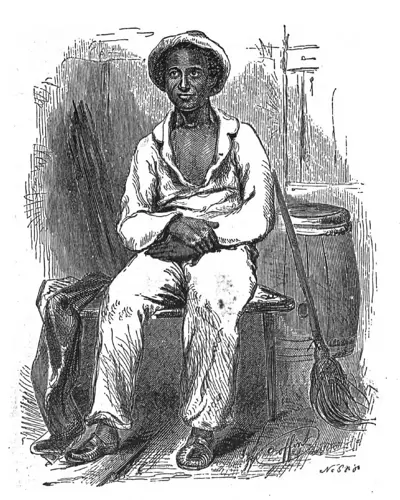
Solomon Northup was an American abolitionist and the primary author of the memoir Twelve Years a Slave. A free-born African American from New York, he was the son of a freed slave and a free woman of color. A farmer and a professional violinist, Northup had been a landowner in Hebron, New York. In 1841, he was offered a traveling musician's job and went to Washington, D.C. (where slavery was legal); there he was drugged, kidnapped, and sold as a slave. He was shipped to New Orleans, purchased by a planter, and held as a slave for 12 years in the Red River region of Louisiana, mostly in Avoyelles Parish. He remained a slave until he met a Canadian working on his plantation who helped get word to New York, where state law provided aid to free New York citizens who had been kidnapped and sold into slavery. His family and friends enlisted the aid of the Governor of New York, Washington Hunt, and Northup regained his freedom on January 3, 1853.
