Esek Hopkins Quotes
Slaves Rose on us--was obliged fire on them and Destroyed Eight and Several more wounded badly Captives became so Dispirited after the failed insurrection that Some Drowned themselves, Some Starved and others Sickened & Dyed.
The Sally was owned by Nicholas Brown and Company and this voyage was financially unsuccessful with 109 out of 196 slaves dying in board. Brown, of the family that founded Brown University, was discouraged by this voyage and withdrew from the slave trading business. See {641475}. American naval hero, John Paul Jones, served under Hopkins in the American Revolution.
Esek Hopkins, 1718–1802, Captain & Master of the Slave Ship Sally, Commander in Chief of the American Navy in the Revolution, Ships Log, Voyage from Providence RI, 1764
Sourced by: Eigen's Political and Historical Quotations

The Sally was a ship that belonged to his family business that engaged in a slave trading voyage where many slaves were killed. It was a traumatic experience for Moses Brown and he became a staunch abolitionist and in this letter persuaded other Rhode Island merchants to avoid the slave trade. See {641478} and {585793}.

The point about the negroes who were born into American slavery being less aggressive than those captured and transported to America is often overlooked. Slavery not only was cruel, moral, and inhuman in its own right, but also took its toll over generations as a result of the psychological effects of the terror of slavery. Despite these, it is amazing how resiliant the American Blacks were under those circumstances. in some cases one or two saves escaped after committing a violent act as they had little to lose for trying as they wold be killed if caught. A few of these escaped to the North and others reached Southern Cities like Charleston where there was a small free black community in which they could be absorbed.

This fear was great among many who were abolitionists as potentially there might be mass slaughter of all Southern whites.

Lev Davidovich Bronstein


She was one of the early abolitionists. Despite the Southern attempted repression of information of slave resistance, some of the facts emerged and were well known in the North. The South tried to suppress these incidents lest other slaves get ideas from it. Also the Southerners often maintained that Africa was so primitive and underdeveloped, that the slaves were better off in America; these actions of rebellion belied this notion.

Louis Napoleon Bonaparte. The “colonies” to which we was referring were the French Colonies in the Caribbean—particularly Haiti. The Black slaves had revolted against the slave-owners and had taken over all positions of authority and wore the uniforms and symbols of power including the epaulettes—the gold braid shoulder pieces that were symbols of high rank in military and diplomatic uniforms which were worn on all official occasions. Napoleon never did make good on his vow. He had many more problems with his own wars and governance in Europe. This quote does demonstrate the racism that existed in supposedly tolerant France.
As a British Loyalist officer, he and his men were dispatched to Savannah, Georgia. There he saw the Southern version of slavery for the first time and was shocked at the cruelty. At the end of the Revolutionary war, he and many other loyalists fled to Canada and began his political career, then representing Britain in the Caribbean. See also {591379}.


The language was removed in the negotiations that followed Jefferson's draft.

This is an important quotation because it shows that slavery was the principle reason that the South succeeded and began their rebellion. In the early 20th century, there was a movement to make the Confederacy and the rebellion more noble by promoting the idea that the Civil War was fought by the South for more lofty reasons such as States Rights, Original Construction, different economic philosophies and the like. This was a more noble cause then the right to deny other human beings their rights, to own other human beings who they could beat, torture, sexually use and even murder them was a pretty selfish and demeaning reason to have started a rebellion that would then cost more Americans their lives than any other American conflict. The succession documents and others of the Southern States and the Confederacy make it clear that slavery was THE issue and fleeting references to any of the others were only made to complain about the potential effect on abolition and the refusal of the abolitionist states to cease aiding and protecting fugitive slaves.


In 1831 a slave preacher, Nat Turner, led a rebellion in North Carolina killing over 50 whites. Even though Turner and the rebels were captured and executed, whites throughout the South, took vengeance on any slaves they could find. This description was of a North Carolina community.

In 1831 a slave preacher, Nat Turner, led a rebellion in North Carolina killing over 50 white men, women and children. Even though Turner and the rebels were captured and executed, whites throughout the South, took vengeance on any slaves they could find.
The reason for the initial total killing policy was that the slaves had no arms. Their plan was for a small band to attack a plantation, seize the owner’s arms, free his slaves enlarging the “army”, and going on to the next plantation. The reason for the total killing of the whites was to prevent a survivor running to the authorities and mounting a counter attack on the slaves while they still had few guns. The plan was to form an armed slave army and then fight a conventional battle. Ironically, one white who was wounded and spared actually did reach the authorities and Turner’s band was attacked before they had sufficient weapons to put up a serious fight.

His fear was well founded. That is exactly what the British tried to do.


He was also himself a ship owner in the slave trade and he was the brother of the leading Rhode Island abolitionist, Moses Brown. See {585793}. Brown became the first American, prosecuted in federal court for illegal slave trading –-- a prosecution brought, in part, by his own brother. He was, however, acquitted.
While many of the Indian wars were over land or were defensive in nature, the major motivation for some wars with Indians was pure greed in that captured Indians were sold as slaves.
As a British Loyalist officer, he and his men were dispatched to Savannah, Georgia. There he saw the Southern version of slavery for the first. He questioned the character of the slave owners and most interesting, he tied the consumer enjoyment of Rice and Sugar by Northerners to the suffering of the Negro slaves. At the end of the Revolutionary war, he and many other loyalists fled to Canada and began his political career, then representing Britain in the Caribbean. Also see {591380}.
None was forthcoming. This letter is of great historical interest in that it shows the corrupting influence of slavery on all facets of society.
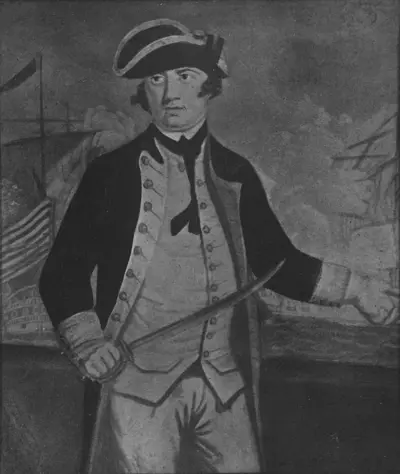
- Born: April 26, 1718
- Died: February 26, 1802
- Nationality:
- Profession:
Commodore Esek Hopkins /ˈiːˌzɛk/ was an American naval officer and slave trader. Hopkins was the only Commander in Chief of the Continental Navy during the American Revolutionary War. He was also an accomplished merchant captain and privateer. He is noted for his successful raid on the British port of Providence, in the Bahamas, and capturing large stores of military supplies.
