Catherine the Great Quotes
All persons who dare to incite serfs and peasants to disobey their landlords shall be arrested and taken to the nearest government office, there to be punished forthwith as disturbers of the public tranquility, according to the laws and without leniency. And should it so happen that even after the publication of the present decree of Her Imperial Majesty any serfs and peasants should cease to give the proper obedience to their landlords ... and should make bold to submit unlawful petitions complaining of their landlords, and especially to petition Her Imperial Majesty personally, then both those who make the complaints and those who write up the petitions shall be punished by the knout and forthwith deported to Nerchinsk to penal servitude for life
In Russia at the time, serfs were little better off than slaves. Not only did they have to obey their landlords in all things, but any who advocated disobedience on their part were beaten and sent to Siberia. Exile to the Siberian Gulags was not an invention of the Communists of the 20th century although they used that punishment in unprecedented numbers. It was used by the Czars and the Empress.
Catherine II ("The Great"), 1729-1796, Empress of Russia, Decree on Serfs, 1767
Sourced by: Eigen's Political and Historical Quotations

Roosevelt was addressing the famous progressive Pennsylvania Governor, Amos Pinchot, 1873-1944. See {589635} or {61590} for an example of a Pinchot Quotation. This was the first time the phrase "lunatic fringe" was used. It has been popular in politics ever since.

The Nationalist/Fascist views in the Spanish Civil War were so gross that they actually hurt the Nationalist cause in International opinion. See {592113} for another example. Despite the facts, most of the Western world was not then knowledgeable about the evils of Fascism and distrusted democracy, socialism, and communism more.

Negotiations regarding the exchange of prisoners and property. This was his view of his supposed obligation to return Negro slaves who had escaped and gone to the British during the war. The treaty of peace specified that all “property” including slaves, taken by, the British be returned to the Americans. But he and other officers did not always do so as they thought they had higher moral obligations. See {621936} for example.

This statement later became known as “The Truman Doctrine.”


At that time, Russia and Germany were autocracy, and the ruler could simply take the English money and force the soldiers to fight in a war they had not stake in nor understood.

Although English, Cobett spent time in America and published a newspaper, The Porcupine Gazette, in Philadelphia. We was very conservative but on the issue of slavery his resembled a liberal point of view. He never used sugar, coffee, or rum because slave labor produced them. However, he advocated legally enslaving lazy people, blacks and whites, who would not work.


Barre, who had served as an officer in North American fighting with the Americans against the French, was a major opponent of the Stamp Act and other efforts to tax the American colonies. In the debate one of his opponents referred the American colonies as “planted by the care of England” and “nourished” by the mother country’s care. Barre was imprisoned in the Tower of London for a while for his vigorous defense of the American colonists.

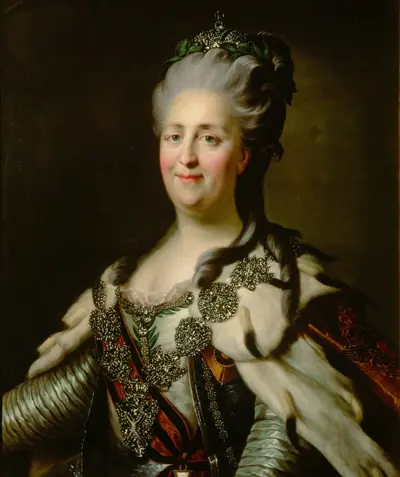
- Born: May 2, 1729
- Died: November 17, 1796
- Nationality: Russian
- Profession: Royalty
Catherine II, most commonly known as Catherine the Great, was empress regnant of All Russia from 1762 until 1796 – the country's longest-ruling female leader. She came to power following a coup d'état that overthrew her husband and second cousin, Peter III. Under her reign, Russia grew larger, its culture was revitalised, and it was recognized as one of the great powers of Europe.
