Harry S. Truman Quotes
At the present moment in world history nearly every nation must choose between alternative ways of life. The choice is too often not a free one. One way of life is based upon the will of the majority, and is distinguished by free institutions, representative government, free elections, guarantees of individual liberty, freedom of speech and religion, and freedom from political oppression. The second way of life is based upon the will of a minority forcibly imposed upon the majority. It relies upon terror and oppression, a controlled press and radio, fixed elections, and the suppression of personal freedoms. I believe that it must be the policy of the United States to support free peoples who are resisting attempted subjugation by armed minorities or by outside pressures. I believe that we must assist free peoples to work out their own destinies in their own way.
This statement later became known as “The Truman Doctrine.”
Harry S Truman, 1884-1972, 33rd President of the United States (Democrat, MO), Address to a joint session of Congress, March 12, 1947
Sourced by: Eigen's Political and Historical Quotations

This statement became known as "The Truman Doctrine." Truman asked for $400 million to help Greece and Turkey fight stave off armed Communist minorities destabilizing their governments.

In Russia at the time, serfs were little better off than slaves. Not only did they have to obey their landlords in all things, but any who advocated disobedience on their part were beaten and sent to Siberia. Exile to the Siberian Gulags was not an invention of the Communists of the 20th century although they used that punishment in unprecedented numbers. It was used by the Czars and the Empress.


Lev Davidovich Bronstein. Trotsky grew disillusioned with the Communist Party Direction (see {634717})and went into exile in Mexico where he was murdered under orders of Stalin.

Graham was a very strong advocate for democracies. However, many politicians advocated staying out of that struggle. They pointed out that Graham was very inconsistent. He opposed the U. S. taking sides in most of the other struggles between democracies and dictatorships such as in Saudi Arabia, Arab Emirates, Kuwait and the dictatorships of Azerbaijan, Zimbabwe, and Burma among others. Graham was a strong anti-Russian and supported countries who were against Russia or with whom Russia was at odds.

After the breakup of the Soviet Union, NATO expanded to include some fo the former Soviet Nations thus moving NATO territiry to the East--closer to Russia, whose leaders percieved that the expansion was hostile and dangerous for the indpendence of Russia. What made the situation more complex is that the American Secretary of State, when the Soviet Union was very powerful, had made an agreement with the Soviets that in return for Russian aquiessance of NATO being extended to East Germany, NATO would not expand further West. But after the collapse of the Soviet Union, Russia was quite weak and NATO expanded east despite the earleir comittment. The US and th eother NATO counties took the pozition the previous comitmnts were not binidng as they were never formally signed. The Russians then decided to take a hard line position and flaunt and use military force to which would stop the Western expansion closer to the Russian border.


1st Baron Tweedsmuir


As Ukraine found out in 2014, Vladimir Putin, President of the Russian Federation, had a similar outlook as the Kremlin of the Soviet Union 70 years earlier.


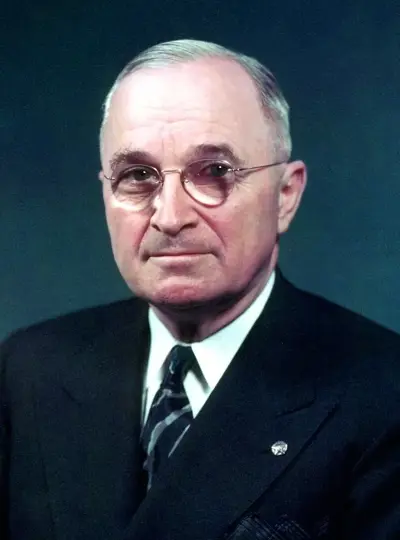
Harry S. Truman was an American politician who served as the 33rd President of the United States (1945–53). He served as a United States Senator from Missouri (1935–45) and briefly as Vice President (1945) before he succeeded to the presidency on April 12, 1945 upon the death of Franklin D. Roosevelt. He was president during the final months of World War II, and approved the plan to drop atomic bombs on Hiroshima and Nagasaki. Truman was elected in his own right in 1948. He presided over an uncertain domestic scene as America sought its path after the war and tensions with the Soviet Union increased, marking the start of the Cold War.
