Maximilien Robespierre Quotes
To punish the oppressors of humanity is clemency; to forgive them is cruelty.
Maximilien Robespierre, 1758-1794, French Jacobin Revolutionist, Member, National Assembly & Committee of Public Safety, View of Amnesty and Clemency of dictators or monarchists
Sourced by: Eigen's Political and Historical Quotations


This proverb only makes sense in the light of understanding the Arab concept of revenge—“blood.” In a rural desert environment where little can be expected of government, the Arabs have developed a law enforcement and peace keeping mechanism which while primitive from modern standards, nevertheless worked to some degree. It is that revenge—“blood” is a moral necessity and obligation of all people, and revenge is not limited by time or to the individuals involved in the first incidence. The immediate family are the first to exact revenge, but the extended family follows and often the entire clan. Sometimes revenge is tribal or even national. Anyone who fails to revenge a member in his group is not only a disgrace, but is a clear and present danger to the group because then they can be attacked with impunity. So revenge is a strong obligation of the group members and blood must be paid with blood no matter how many generations it may take. The only thing that keeps me and my family safe, is the surety what whosoever kills one of us will themselves be killed or if they die a natural death we will take revenge on one of the evildoers relatives and no one is exempt. Crime must never pay!


The Abenaki Indians from Canada had come South and raided many of the settlements of upstate New York. In the process, they committed many atrocities killing civilian men, women and children. Amhurst ordered Robert Rogers and his rangers to attack the Abenaki home villiage in Canada on a famous punitive raid. The Rangers, did indeed, raid the Abenaki and wiped out all the males of the tribe that were in the camp at the time. Amhurst hated Indians, but still had his standards regarding the killing of women and children, but was perfectly willing to kill all the mature males. There were no Geneva Conventions at the time. The same general introduced biological warfare by giving Indians smallpox infected blankets. See {619646}


Later, in 1973, he himself was denounced and sentenced to the guillotine. When he was sentenced, hecklers asked him if his blood was too pure for execution throwing his quotation back at him.

France was coming under great criticism from the rest of Europe for the bloodbath of executions that the Revolution had become. Many French thought that perhaps they were executing too many people. Saint-Just urged them to hold the course and they did.

Unfortunately, his close successors did not share Alexander’s surprisingly modern view.
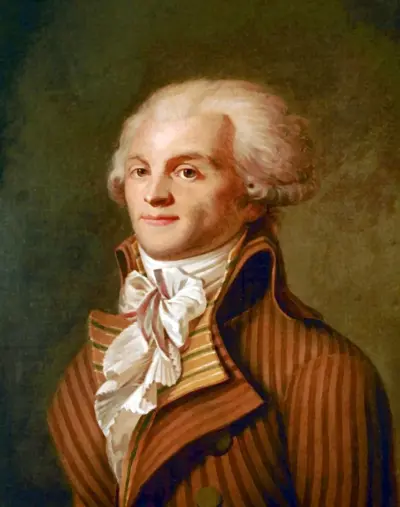
Maximilien François Marie Isidore de Robespierre was a French lawyer and statesman who was one of the best-known and most influential figures of the French Revolution. As a member of the Constituent Assembly and the Jacobin Club, he campaigned for universal manhood suffrage and the abolition both of celibacy for the clergy, and slavery. In 1791, Robespierre became an outspoken advocate for the citizens without a political voice, for their unrestricted admission to the National Guard, to public offices, and for the right to carry arms in self-defence. Robespierre played an important part in the agitation which brought about the fall of the French monarchy on 10 August 1792 and the summoning of a National Convention. His goal was to create a one and indivisible France, equality before the law, to abolish prerogatives and to defend the principles of direct democracy.
