David Ricardo Quotes
There is no way of keeping profits up but by keeping wages down.
At the time this was generally true for most businesses. However, in a modern economy, there are other ways. Increasing volume, automation, innovating products and services to get premium prices naw are standard techniques.
David Ricardo, 1772-1823, English Political Economist & Member of Parliament, On Protection to Agriculture, 1820
Sourced by: Eigen's Political and Historical Quotations


The company’s profits were $5.7 billion--$45,000 per employee. He then imposed a 6 year wage freeze on long term employees and cut the wages of new employees. His compensation has increased 80 percent in the last 2 years. Most large corporation CEOs do not share this need for “unlimited” profits. Most set a target and then try and get the corporate team to reach or exceed it.


While it was true that wages did not increase beyond inflation, the enormous increase in productivity—about a doubling—was not only due to the workers but was also due to the capital investment that the companies made in computers, robots, job restructuring, advanced training, and other management initiatives. Historically, when there are substantial productivity increases, the benefit is shared between the workers and the company as both were necessary to produce the increase in productivity. But since 1980, the workers have not obtained any significant share of the productivity increase.

In the interview Bell was interviewed about the protection the Bush administration was giving to the steel industry.


At the time, industrialists could not even conceive of the notion of negotiating over wages must less collective bargaining.


The reason the age rave grows faster than the median is that there are some earners at the top who increase by huge amounts while the rest of the population did not grow by much. This is the same phenomenon in England that occurred in the United States in the same period, only the United States differential was even greater.


This is not a common quotation from Thoreau. The great man for whom the establishment had so much respect had a very anti-capitalist streak. His view is that the employer will generally never pay his laborers a fair wage. Instead he will pay the laborer the lowest rate for which he can obtain the laborers services. If the laborer generates added value for his wage, the employer is in a zero sum game with the laborer. If part of the added value—the profit is paid to the laborer, the employer does not have it for himself (or his stockholders). In most cases, the laborer is forced to work for his and his family’s subsistence. This theory argues that they only way the laborer will get a fair wage is if there is a labor shortage (assuming no government laws or union pressure is in the picture. Many capitalists argue that a “fair” wage is what a free man is willing to work for and a free employer is willing to pay. So economics is like politics in general with respect to fairness—there is no universally accepted definition of what is fair.
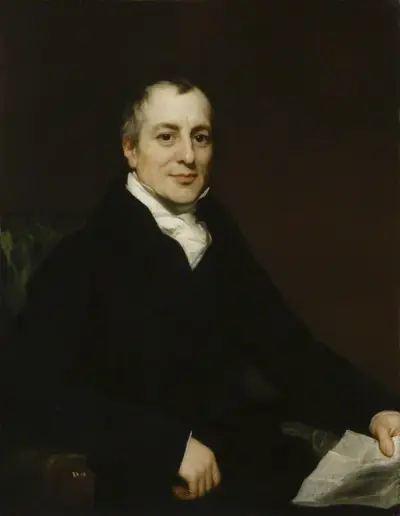
David Ricardo was a British political economist, one of the most influential of the classical economists along with Thomas Malthus, Adam Smith and James Mill. He was also a politician, and a member of the Parliament of Great Britain and Ireland.
