Adam Smith Quotes
Masters are always and everywhere in a sort of tacit, but constant and uniform combination, not to raise the wages of labor.


At the time this was generally true for most businesses. However, in a modern economy, there are other ways. Increasing volume, automation, innovating products and services to get premium prices naw are standard techniques.


the Bolshevik Communists of Russia Zenzinov was often a critic of the Bolsheviks.
Karl Marx had argued that all profit and income from capital is exploitation. Aftalion rebutted Marks as this quotation illustrates.


Description of pre Industrial Revolution wage controls. Generally, they were quite popular with employees and employers alike. There was also a great deal of price fixing. These produced stability whenever weather of disease affected the labor force and eliminated continuous labor/management strife whenever conditions changed. There were no unions or other labor organizations and the Justice of the Peace was the de facto arbitrator of a compulsory arbitration. There was also a perception of fairness and not just economic power determining decisions. With the industrial revolution, the number of different jobs and skills exploded and the old system was no longer practical. This started hundreds of years of labor / management approaches with none yet considered ideal. This is another example of how modernization brings additional problems along with the great benefits by which all of us are healthier, wealthier, better educated, have more leisure time, more freedom and control over our own lives.
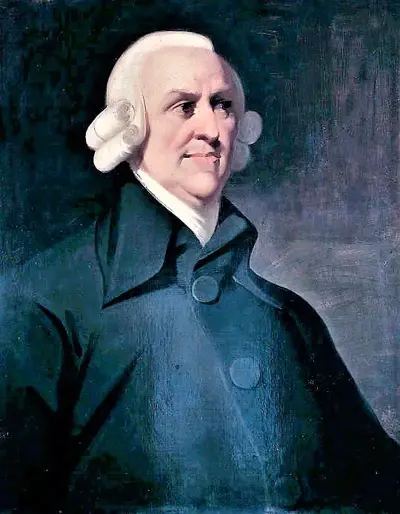
Adam Smith FRSA was a Scottish economist, philosopher as well as a moral philosopher, a pioneer of political economy, and a key figure during the Scottish Enlightenment, also known as ''The Father of Economics'' or ''The Father of Capitalism''. Smith wrote two classic works, The Theory of Moral Sentiments (1759) and An Inquiry into the Nature and Causes of the Wealth of Nations (1776). The latter, often abbreviated as The Wealth of Nations, is considered his magnum opus and the first modern work of economics. In his work, Adam Smith introduced his theory of absolute advantage.
