William Jennings Bryan Quotes
You shall not press down upon the brow of labor this crown of thorns, you shall not crucify mankind upon a cross of gold.
Referring to the gold standard:
William Jennings Bryan, 1860-1925, U. S. Secretary of State, U. S. Congressman (Democrat, NB), 3 Time Unsuccessful Democratic Presidential Candidate, "Cross of Gold" Speech, Democratic National Convention, Chicago, IL, July 8, 1896
Sourced by: Eigen's Political and Historical Quotations

At the time the United States was on the Gold Standard and all our money was backed by gold. Root and others were afraid that a Federal Reserve Bank, a proposal that was being debated in Congress, would cause a large amount of paper money to be printed which other nations would obtain through trade and then exchange that for American gold—a process which would deplete the American gold supply. A few years before, William Jennings Bryan had argued that the Gold Standard did not allow America sufficient ability to increase the money supply to serve the growing population and economy. See {640992}.

In 1897 one of the most contentious political issues in America was that of “free silver”—allowing silver to back American currency as well as gold. The country’s economy could not grow because more currency could not be issued for want of gold to back it. Meanwhile, the U. S. had a great deal of silver. William Jennings Bryant {640992} and the Democrats {591769} advocated free silver, and the Republicans fought to maintain the gold standard. The president of the very conservative Brown University advocated free silver to the shock of the trustees. They sent Andrews a letter asking him not to speak publicly on the subject as it would jeopardize donations and endowments. Andrews resigned. The incident caused a national furor about academic freedom with the public and most of the alumni siding with Andrews. He rescinded his resignation but was pushed out the following year. Later, the trustees named a building after him.


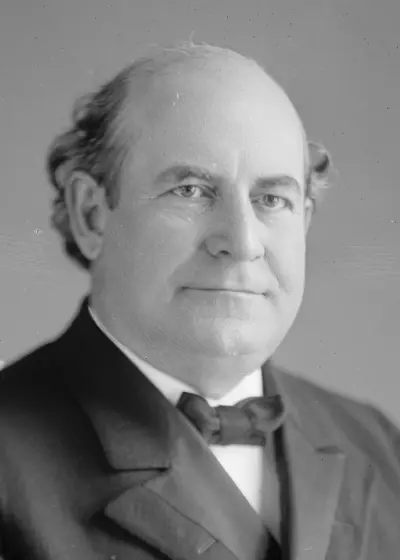
William Jennings Bryan was an American orator and politician from Illinois and Nebraska. Beginning in 1896, he emerged as a dominant force in the Democratic Party, running three times as the party's nominee for President of the United States in the 1896, 1900, and 1908 elections. He also served in the United States House of Representatives and as the United States Secretary of State under Woodrow Wilson. Because of his faith in the wisdom of the common people, he was often called "The Great Commoner".
