Paul Krugman Quotes
… immigration reduces the wages of domestic workers who compete with immigrants. That’s just supply and demand: we’re talking about large increases in the number of low-skill workers relative to other inputs into production, so it’s inevitable that this means a fall in wages.


For another of his immigration quotes and that of another labor leader, see {639891} and {639896}.

The nation was divided over the issue of immigration. Many observed that the vast majority of the immigrants—especially the illegal immigrants performed jobs for which American workers could not be hired. Opponents like the congressman, claimed that if better wages were paid Americans would be doing the jobs, and as long as there were immigrants who would work for low wages, there was little reason for employers to pay more.


In many cases, one spouse is a citizen and the other is not; or the parents might be but not the children; of the children were born in the United States but the parents were not citizens and had no documentation. Under the broken immigration system then, the government would actually deport one family member. Sometimes it was the breadwinner and the legal wife and children would then be forced onto welfare, the taxpayers would have to pay for a family that was doing fine until the government intervened; worst, the children would be kept apart from their father who could not even visit them thereafter. It was the only circumstance in the American system where government would actually destroy families when “family friendliness” was the official policy.

Ironically, where national quotas have been used in American immigration policy, it has rarely been used to keep nationals of countries with which we were having difficulty, out. In almost all cases, the national quotas have been used to discriminate against racial and religious minorities in America. Asians, Blacks, Hispanics, Catholics, Mormons and Jews have been the most frequent groups targeted. Even when we were in the midst of the Cold War, American policy was to accept immigrants from the Soviet Union and Cuba enthusiastically.


Magazine of the Council of Conservative Citizens

The senator was commenting about the problem of illegal immigration.

The United States policies at the time encouraged tens of thousands of foreigners to study in America—especially mathematics, science and engineering. Then after they graduate we expel them despite the fact that we have a great labor shortage of these technical skill areas. The result is that the American economy lags in one of its most important areas, high technology for lack of qualified people to fill the jobs. Larger American companies then set up operations overseas and hire many of the people who we kicked out, so they do not pay any taxes to America. The best and most ambitious of these American trained foreigners, then start their own businesses abroad, create many jobs that never benefit Americans and then sell to America competing with American firms. New York City alone had tens of thousands of open jobs at very high salaries for which there were no Americans to fill while the New York schools had trained enough foreigners to fill the jobs, but our national policies forced the best and the brightest to leave and compete with us.


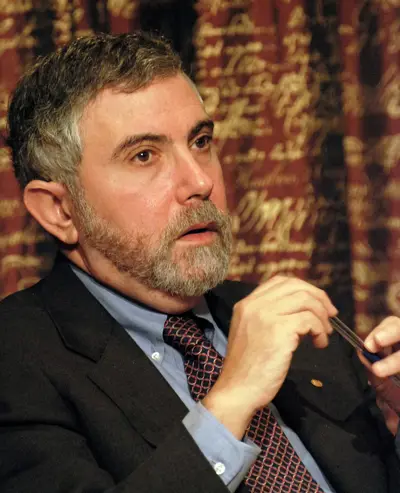
- Born: February 28, 1953
- Nationality: American
- Profession: Economist
Paul Robin Krugman is an American economist who is the Distinguished Professor of Economics at the Graduate Center of the City University of New York, and a columnist for The New York Times. In 2008, Krugman was awarded the Nobel Memorial Prize in Economic Sciences for his contributions to New Trade Theory and New Economic Geography. The Prize Committee cited Krugman's work explaining the patterns of international trade and the geographic distribution of economic activity, by examining the effects of economies of scale and of consumer preferences for diverse goods and services.
