Adam Smith Quotes
Wages tend to an equality in the same neighborhood and the same occupation.
Adam Smith, 1723-1790, Scottish Political Economist, The Wealth of Nations, 1776
Sourced by: Eigen's Political and Historical Quotations

The good jobs that support middle and upper middle class lifestyles are growing at a lesser rate than the minimum and low wage jobs.

The last 5 years of the 1990s were the last of the Clinton administration where he was the principle architect of economic policies for that period. While this statement was somewhat self serving, the economic and fiscal performance of the Clinton years were astoundingly superior to those before and after.

This is not a common quotation from Thoreau. The great man for whom the establishment had so much respect had a very anti-capitalist streak. His view is that the employer will generally never pay his laborers a fair wage. Instead he will pay the laborer the lowest rate for which he can obtain the laborers services. If the laborer generates added value for his wage, the employer is in a zero sum game with the laborer. If part of the added value—the profit is paid to the laborer, the employer does not have it for himself (or his stockholders). In most cases, the laborer is forced to work for his and his family’s subsistence. This theory argues that they only way the laborer will get a fair wage is if there is a labor shortage (assuming no government laws or union pressure is in the picture. Many capitalists argue that a “fair” wage is what a free man is willing to work for and a free employer is willing to pay. So economics is like politics in general with respect to fairness—there is no universally accepted definition of what is fair.
The reason the age rave grows faster than the median is that there are some earners at the top who increase by huge amounts while the rest of the population did not grow by much. This is the same phenomenon in England that occurred in the United States in the same period, only the United States differential was even greater.


At the time this was generally true for most businesses. However, in a modern economy, there are other ways. Increasing volume, automation, innovating products and services to get premium prices naw are standard techniques.


This is the major argument always given against raising the minimum wage. Historically, however, when the minimum wage has been increased there has never been a large increase in the unemployment rate. However, if the increase would be huge it would likely have the effect of pricing some workers out of the market. Like so many other elements of politics, moderation is important.


The debate over income inequality generally ranges between the two extremes of Christie’s hypothetical equal, mediocre salary to the extreme wealth of the 1% controlling most of the wealth. However , where America was moving in its most general affluent times was not towards equal compensation, but to a large range of remuneration with the low end and middle constantly increasing over time and the high end a reasonable multiple of the low end. However, the breakdown came in the last decades of the 20th century and the early 21st century when the low end did not increase (discounting for inflation) in 40 years, nor did the middle, while the high end increased enormously. So the nation had 40 years of growth without the lower or middle classes benefitting much and all the benefit going to the wealthy and most of that to the very wealthy. Thus the instinct was to tax the wealthy more heavily and spending the money to increase opportunity for the lower and middle classes. However, the political battle was waged over the taxing issue and not on what could be done to have the poor and the middle class obtain a larger proportion of the growth and a smaller percentage of the setbacks.


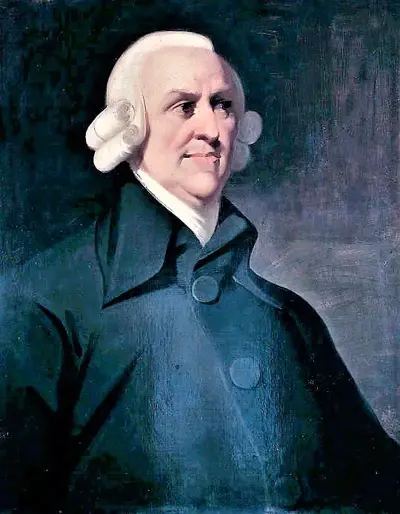
Adam Smith FRSA was a Scottish economist, philosopher as well as a moral philosopher, a pioneer of political economy, and a key figure during the Scottish Enlightenment, also known as ''The Father of Economics'' or ''The Father of Capitalism''. Smith wrote two classic works, The Theory of Moral Sentiments (1759) and An Inquiry into the Nature and Causes of the Wealth of Nations (1776). The latter, often abbreviated as The Wealth of Nations, is considered his magnum opus and the first modern work of economics. In his work, Adam Smith introduced his theory of absolute advantage.
