Edward Mandell House Quotes
The United States, after having risen to heights of courage and idealism in its entry and prosecution of the war, has gone to the other extreme in the making of peace. For taking this course history will probably be even less sparing of us than our present-day critics.
Edward Mandell House, 1858-1938, Army Colonel and Aide to President Wilson & President Taft, “The Running Sands”, Foreign Affairs, March 1923, [It was.]
Sourced by: Eigen's Political and Historical Quotations


Nicolson was an eyewitness to the proceedings.

Their fear was that wages in Germany would be greatly depressed by the requirement for reparations. And it was the capitalists of the world that had loaned money to the powers to finance the war. Most of the reparations they feared would go to repay those loans.


He was at that time the chosen delegate to the peace conference. The government officials were unhappy with their agreement. Ataturk overruled the government and the treaty was signed.


Referring to the peace negotiations following World War I: 1st Earl Lloyd-George of Dwyfor


The Japanese had gotten into World War II by insisting that they had the right and necessity to expand their empire by invading Korea, Manchuria, and parts of China. To them, it was “merciless”, for the United States and other nations to insist that they stay on their own Islands. At the time Japan had a growing population and a small, fixed amount of land. The Japanese mainland had minimal natural resources. The Japanese distrusted the notion of international trade to provide them with their necessities, so the expansionist policies were perceived to be necessary for survival. The great irony was that after Japan had all these “merciless” peace terms imposed on them, they were forced into international trade, where they did extremely well and gained more affluence and world influence than they had ever dreamed of under the militarism of Hirohito’s administration.

In the history of diplomacy and peace treaty negotiations, the various national representative would meet in secret, negotiate treaties and add secret clauses. Then the treaty was finally made public for approbal or ratification in the different countries no one would be told of the secret clauses. Each side would have a written secret copy of these clauses, but the publics of the country would never know. For example, the agreements about various WWII issues that were secret have not yet been made public in the United States or England. Wilson wanted to put an end to that diplomatic ploy and wanted all the peace treaty clauses to be public with nothing secret. He also wanted the deliberations to made in public woth press access. He had little support for the idea in most European nations.


This illustrates one of the reasons that the Israeli Arab conflict has been unsolvable over the years. A thousand years ago, the Arabs were a leading intellectual and military power in the world. The rest of the world has moved ahead and they have actually retrogressed. So the Arabs seek dignity which is very elusive. They have never wanted to negotiate terms with Israel when they have been weak and feel defeated. So the pattern has been that they feel they cannot negotiate for justice as they are too week. So periodically they attack Israel which has always defeated them and hoped that after the Arab defeat, permanent negotiations for peace could take place. But the Arabs were feeling too weak. So they just repeated all their extreme demands. After a few years, they would try another attack, lose again and the cycle would repeat. The Israelis fear that if the Arabs every won a war, the Arab moderates might be willing to reasonably negotiate, the extremists would want to continue the fighting and “drive the Israelis into the sea” as they have so often threatened.

Vladimir Lenin

since the end of WWI The railroads were nationalized for WWI and he ran them all as a government official


Unfortunately, the prime minister turned out to be very accurate in his predictions. The Second World War functioned just as he said.

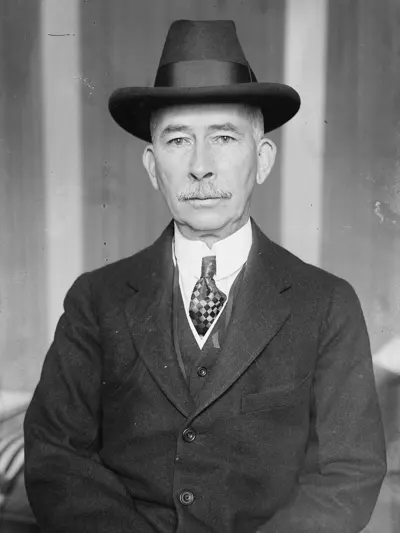
Edward Mandell House was an American diplomat, and an advisor to President Woodrow Wilson. He was known by the nickname Colonel House, although he had performed no military service. He was a highly influential back-stage politician in Texas before becoming a key supporter of the presidential bid of Wilson in 1912. Having a self-effacing manner, he did not hold office but was an "executive agent", Wilson's chief advisor on European politics and diplomacy during World War I (1914–18) and at the Paris Peace Conference of 1919. In 1919 Wilson, suffering from a series of small strokes, broke with House and many other top advisors, believing they had deceived him at Paris.
