Jan Pietersz Coen Quotes
The sweetest violence to keep our enemies in check without resorting to open war is to populate the lands with our own people and fill them to such an extent that we instill respect in our feigned friends, the English, fear in our enemies, and obedience in the rebellious. Large numbers of people are the principal foundation of the Company's state in the Indies, without which it cannot exist.
He was a great believer in moving large numbers of Dutch settlers to the Dutch colonies in the East Indies.
Jan Pietersz Coen, 1587-1629, Governor General of the Dutch East Indies, Report to the East India Company Board of Directors, 1623
Sourced by: Eigen's Political and Historical Quotations

One of the reasons that Jefferson and others were so anxious to expand the territory of the United States was that Britain had operated with the policy that curtailed and limited the population growth of the American colonies and the resentment of this policy led to growth of America and the Westward expansion.


Dutch colonial administration was the responsibility of the Dutch East India Company.


In 1832 the President sent Edmund Roberts, a New Hampshire sea captain, to arrange commercial treaties with Asian countries such as Burma, Indo-China, Siam and Japan:


The French had arrived there first an “claimed” the area with a tiny military contingent under Lieutenant Marchand. However, the British arrived afterward with a much larger military force. London and Paris decided that the French should withdraw in favor of the British. Delcasse had been right. Another case of “might makes right.”


Not all whites were allowed to usurp all Indian lands. There were many attempts to limit white settlement to avoid friction with the Indians although the overall tendency was for the whites to take over and dominate the land.
Even at this early time, it was clear that whites had brought numerous diseases that decimated the Indians. Alcohol and disease killed many more native Americans than all the wars—intertribal and with the whites—ever did. Neolin warned but did not have more than regional influence.

When the British first colonized South Africa, the area they used was akmost uninhabited or very sparcely so. However, some Black tribes (including the Zulus) were moving from the north and themselves were colonizing or annexing the areas to their kingdom. The British were most interested in Trading so did not have large land asperations. The Dutch white Boer Africanners, in contrast, wanted to farm the lands and use the range for their cattle. They wanted the land. The English policy was that there would be friendly relations with the Black tribes surrounding their Cape Colony and no one should take their land. However the Boers started attacking the Black areas and seizing their farms and villages. At first, the English assumed that the Blacks would easily be able to ward off the invasion as the Afrikanners had no professional troops like the British. However, the neighboring tribes were not very warlike or good fighters. They were being overrun by the Zulus coming from the North and the Boers from the South. The British Government had a real problem in that they would have to have British soldiers fight the white Afrikanners if they wanted to stop the illegal white invasions. This was the root of the Boer War where the British would be fully at war with the Africanners.


His idea was to send English people who were vagabonds, paupers, failures, and never do wells to America. These people in England were just “waste”. But in America, the could be apprenticed or become indentured servants, learn skill and they would (and indeed did) become the corps of laborers needed to cut down the trees, beat the hemp (for making rope), gather honey, salt and dry fish, dress raw animal hides, dig the earth for minerals, raise olives and silk, and sort and pack bird feathers. In England they were so desperate that they would work in the difficult conditions of the colonies and would be willing to venture out from the country and culture in which they existed—a major problem in getting colonial workers.

Over a decade later a leading English politician realized the same possibility and took steps to prevent it {636871}. Brazil was a colony of Portugal which grew at so fast a comparative rate, that Brazil became many times the size of the original mother country.


The Irish Earls of Ulster, after a failed rebellion against English rule, fled to the European continent. As Chichester realized, this created an opportunity for the King to name new Earls and grant them the lands and possessions of the Earls who had fled. And since the Irish people were loyal to their traditional Earls. He suggested that English and Scots colonists be recruited to settle the lands. The King agreed and referred to the project as the “Ulster Plantation”. This was the reason that Northern Ireland had a much larger Protestant population percentage than the rest of Ireland and wanted to remain part of England when Ireland obtained its independence.

At the time, Capetown was under the control of the Dutch East India Company which had recruited Gordon from Scotland. There was a wave of liberality following the Enlightenment, the American Revolution, and the very vocal English, anti-slavery, reformers. The Dutch were concerned mainly with making money, and that they thought that meant stability and the status quo. Gordon was their strong spokesman on this. Like American Southern slave owners, Gordon read the Bible as God endorsing slavery and the inferiority of Blacks. Thus, reformers did not "believe in God any more".


_0_thumbnail_47x47.jpg)
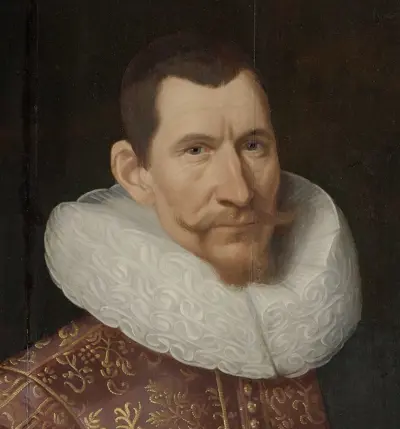
Jan Pieterszoon Coen was an officer of the Dutch East India Company (VOC) in the early 17th century, holding two terms as Governor-General of the Dutch East Indies. He was the founder of Batavia, capital of the Dutch East Indies. Renowned for providing the impulse that set the VOC on the path to dominance in the Dutch East Indies, he was long considered a national hero in the Netherlands. Since the 19th century, his legacy has become controversial due to the violence he employed, especially during the last stage of the Dutch conquest of the Banda Islands, in order to secure a trade monopoly on nutmeg, mace and clove.
