Cecil Rhodes Quotes
In order to save the forty million inhabitants of the United Kingdom from a bloody civil war, our colonial statesmen must acquire new lands for settling the surplus population of this country, to provide new markets... The Empire, as I have always said, is a bread and butter question.
Cecil Rhodes, 1853-1902, Prime Minister of Cape Colony (South Africa), Quoted in William Simpson; Martin Desmond Jones. Europe, 1783-1914, 2000
Sourced by: Eigen's Political and Historical Quotations

Over a decade later a leading English politician realized the same possibility and took steps to prevent it {636871}. Brazil was a colony of Portugal which grew at so fast a comparative rate, that Brazil became many times the size of the original mother country.

Describing England and other Colonial Powers: America’s first political economist

One of the reasons that Jefferson and others were so anxious to expand the territory of the United States was that Britain had operated with the policy that curtailed and limited the population growth of the American colonies and the resentment of this policy led to growth of America and the Westward expansion.

This was written just before Japan annexed Korea. See {613106}. It is true that Australia with vast land areas at the time was very racist and would only admit whites. America allowed some Asian immigration but limited it severely. After Japan’s defeat in WWII they solved their problem very easily. They practiced birth control and in the early 21st century Japan had a negative population growth. After World War II, there was a huge international emphasis on birth control and family planning as WWII in Asia was in part the result of overpopulation in Japan.


This is one of he earliest uses of the term “policemen of the world.”

In order to develop the country she invited immigrants to come to Russia and many did at the same time that England was encouraging immigrants to develop the lands and resources of America

This was a tragic prediction for some as it was used as a theoretical reason for little intervention in the Irish famine a few decades later. The then population density is exceeded by many countries today.

He was a great believer in moving large numbers of Dutch settlers to the Dutch colonies in the East Indies.

His idea was to send English people who were vagabonds, paupers, failures, and never do wells to America. These people in England were just “waste”. But in America, the could be apprenticed or become indentured servants, learn skill and they would (and indeed did) become the corps of laborers needed to cut down the trees, beat the hemp (for making rope), gather honey, salt and dry fish, dress raw animal hides, dig the earth for minerals, raise olives and silk, and sort and pack bird feathers. In England they were so desperate that they would work in the difficult conditions of the colonies and would be willing to venture out from the country and culture in which they existed—a major problem in getting colonial workers.
Gustav II Adolph. The colony would also exclude slavery, and to make a home for the oppressed of all Christendom. Essentially this was the first plan for multicultural diversification of American immigration. The 30 Years War put the project on hold until after the king’s death and it was not until 1638 that Swedish ships sailed for what they called “New Sweden” landing at Wilmington, Delaware, calling it Christina.

The French were at the time considered the major barrier to growth and development of the colonies.


5th Earl of Rosebery


He was addressing the Conservatives of Ulster, the Northern Ireland province that was the center of the Orangemen movement of Irish Protestants who were fighting to retain 'Protestant Ascendency' -- which was the social, political and cultural domination of the Protestants (the minority) over the Catholics (the majority). This was best achieved by keeping Ireland a part of Great Britain as opposed to having Ireland as a separate, independent country.
After Henry VIII changed England to a Protestant nation and left the Roman Catholic Church, the Catholic countries of Europe, England’s traditional trading partners, were not as available as before. The English Economy was in great danger. Queen Elisabeth I however initiated policies to turn East for new markets and trading partners and found munitions a great export area. Since the Catholic Church was boycotting England, she seized their property and used much of it to capitalize and provide raw martial for her new industry.


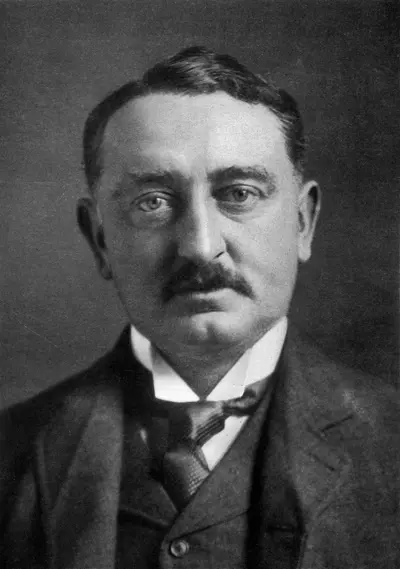
Cecil John Rhodes PC was a British mining magnate and politician in southern Africa who served as Prime Minister of the Cape Colony from 1890 to 1896. An ardent believer in British imperialism, Rhodes and his British South Africa Company founded the southern African territory of Rhodesia (now Zimbabwe and Zambia), which the company named after him in 1895. South Africa's Rhodes University is also named after him. He also put much effort towards his vision of a Cape to Cairo Railway through British territory. Rhodes set up the provisions of the Rhodes Scholarship, which is funded by his estate.
