Josiah Strong Quotes
Heretofore there has always been in the history of the world a comparatively unoccupied land westward, into which the crowded countries of the East have poured their surplus populations.
Strong, Josiah. Our Country: Its Possible Future and Its Present Crisis. The Baker and Taylor Co., 1885, p. 174.


This was written just before Japan annexed Korea. See {613106}. It is true that Australia with vast land areas at the time was very racist and would only admit whites. America allowed some Asian immigration but limited it severely. After Japan’s defeat in WWII they solved their problem very easily. They practiced birth control and in the early 21st century Japan had a negative population growth. After World War II, there was a huge international emphasis on birth control and family planning as WWII in Asia was in part the result of overpopulation in Japan.

English owners of Irish Estates did not get along with the Irish natives very well. They were perceived by most Englishmen as uncivilized, primitive barbarians who were not hard workers or industrious people. Further, England had turned Protestant and made Ireland such, and the Roman Catholic Irishment did not want to have much to do with the English who were occupying their land and robbing them of their religion. So the English estate managers sought to induce English to settle in Ireland.

His idea was to send English people who were vagabonds, paupers, failures, and never do wells to America. These people in England were just “waste”. But in America, the could be apprenticed or become indentured servants, learn skill and they would (and indeed did) become the corps of laborers needed to cut down the trees, beat the hemp (for making rope), gather honey, salt and dry fish, dress raw animal hides, dig the earth for minerals, raise olives and silk, and sort and pack bird feathers. In England they were so desperate that they would work in the difficult conditions of the colonies and would be willing to venture out from the country and culture in which they existed—a major problem in getting colonial workers.


One thing that made this a very unusual declaration was that in 1381 an act (see {616281}) was passed in England which prohibited anyone from leaving the country without the express permission of the monarch. In this case she gave Gilbert the right to take any Englishman who wanted to go. With all the rights of Englishmen from Magna Carta on down, the right of emigration did not appear until modern times.

Gustav II Adolph. The colony would also exclude slavery, and to make a home for the oppressed of all Christendom. Essentially this was the first plan for multicultural diversification of American immigration. The 30 Years War put the project on hold until after the king’s death and it was not until 1638 that Swedish ships sailed for what they called “New Sweden” landing at Wilmington, Delaware, calling it Christina.

Genocide generally means the intentional destruction and elimination of a people. In the case of Columbus and the Spanish Conquistadors, they thought little of the lives of the indigenous people of the New World, but they wanted them for slaves to extract the gold and silver. They wiped out several peoples, mostly as a result of the communicable diseases (mainly smallpox) they brought from Europe for which the South Americans had little or no immunity. Also the size of the invasion forces (the Spanish) was relatively small. The size in land and number of people who they invaded was huge. The Spanish were the worst of the European empires from the point of view of the native colonized people. And Columbus was the trigger. So Chavez has a point in castigating Columbus and the Spanish but, typically, and like many politicians, his oratory lacked the precision of total accuracy.

Describing England and other Colonial Powers: America’s first political economist


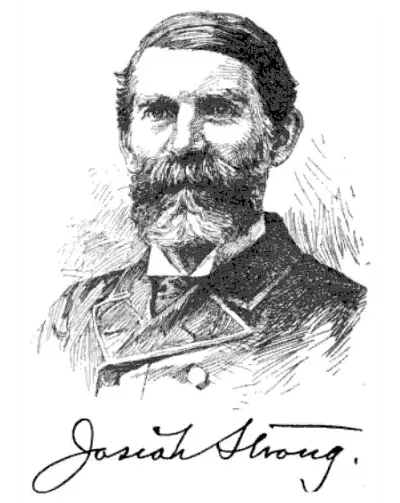
Josiah Strong was an American Protestant clergyman, organizer, editor and author. He was a leader of the Social Gospel movement, calling for social justice and combating social evils. He supported missionary work so that all races could be improved and uplifted and thereby brought to Christ. He is controversial, however, due to his beliefs about race and methods of converting people to Christianity. In his 1885 book Our Country, Strong argued that Anglo-Saxons are a superior race who must "Christianize and civilize" the "savage" races, which he argued would be good for the American economy and the "lesser races".
