Thomas Malthus Quotes
The land in Ireland is infinitely more peopled than anywhere else; and to give full effect to the natural resources of the country, a great part of the population should be swept from the soil.
This was a tragic prediction for some as it was used as a theoretical reason for little intervention in the Irish famine a few decades later. The then population density is exceeded by many countries today.
Thomas Malthus, 1766-1834, British Cleric and Economist, Statement to a journalist, 1817
Sourced by: Eigen's Political and Historical Quotations


Often referred to as “Father of the Green Revolution” for his contributions to food growing throughout the world

From a technical and production point of view, there is no practical limit to population size that is imposed by food production. We can produce sufficient food for the world even if population increases dramatically. None the less, even today we have some starvation and much malnutrition problems. These however are political, economic and tend to be distributional. We can produce the food. Morris does NOT advocate large population growth. Although food need not be a problem with an expanding population, job availability, medical care, energy, land, natural resources, ethnic hatred, migration, violence, and other problems are produced by population growth.


This was written just before Japan annexed Korea. See {613106}. It is true that Australia with vast land areas at the time was very racist and would only admit whites. America allowed some Asian immigration but limited it severely. After Japan’s defeat in WWII they solved their problem very easily. They practiced birth control and in the early 21st century Japan had a negative population growth. After World War II, there was a huge international emphasis on birth control and family planning as WWII in Asia was in part the result of overpopulation in Japan.


inefficient crop yields per acre


The relationship of population increase economic growth is a critical one. If an underdeveloped country manages to have a 3% annual economic growth rate and also has a 3.2% population growth, at the end of the year, the average person is actually poorer than he was the previous year. South Korea, China, Thailand and India implemented successful population control and family planning programs before they were able to take advantage of economic development. To modernize, the country must be able to have a surplus of funds which can be invested in roads, schools, hospitals, and other facilities which can produce even more growth later. Too many new mouths to feed, clothe and care for can be a barrier to development even if the economy is reasonably good.

The word “proprietor” at the time meant someone who had title to land. The title was then almost always tied up with the aristocratic titles. “Great proprietors” were therefore nobles who owned and controlled large land holdings. The “improvers” tended to be the businessmen—especially the manufacturers and the transportation magnates. Large landowners could just make money by renting parts of their land to tenant farmers. They needed no capital, no vision, not much skill or talent, and they didn’t have to take any risks.


Use included renting it. What he opposed was simply holding land when whites were driving Indians off their lands because all the unused land outside of the reservation was owned by someone and the asking price was very high. Ingersoll was considered to be the greatest orator and political thinker of his day, but his overt atheistic views curtailed his elected political career.


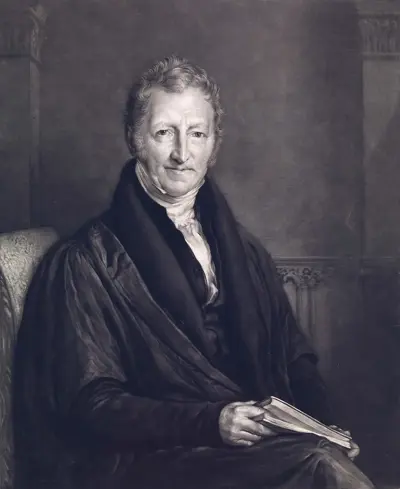
Thomas Robert Malthus FRS was an English cleric, scholar and influential economist in the fields of political economy and demography.
