Adam Smith Quotes
It seldom happens, however, that a great proprietor is a great improver.
The word “proprietor” at the time meant someone who had title to land. The title was then almost always tied up with the aristocratic titles. “Great proprietors” were therefore nobles who owned and controlled large land holdings. The “improvers” tended to be the businessmen—especially the manufacturers and the transportation magnates. Large landowners could just make money by renting parts of their land to tenant farmers. They needed no capital, no vision, not much skill or talent, and they didn’t have to take any risks.
Adam Smith, 1723-1790, Scottish Political Economist, The Wealth of Nations, 1776
Sourced by: Eigen's Political and Historical Quotations


Use included renting it. What he opposed was simply holding land when whites were driving Indians off their lands because all the unused land outside of the reservation was owned by someone and the asking price was very high. Ingersoll was considered to be the greatest orator and political thinker of his day, but his overt atheistic views curtailed his elected political career.


In order to develop the country she invited immigrants to come to Russia and many did at the same time that England was encouraging immigrants to develop the lands and resources of America


inefficient crop yields per acre


This was an incredible prediction that few people thought was possible. This speech was given in the early days of WWII when it was far from clear that we would win.

After Nixon was elected, he never did very much to make Black Capitalism come to pass, but he did make the concept a more respectable idea and it has grown slowly since.


Leading English politicians were warning of the cost of occupying Iraq. The political and military effort did not go well either. See {585253}. The development costs were even more massive in the ill-fated George W. Bush, invasion and occupation of Iraq in the early 21st century. The English policy makers like the Bush administration were expecting a more welcoming reaction. See {585250}.
Colman’s view that business failures contributing to society may be more important than the contributions of the wealthy and successful has been a common theme where failed business men make great politicians (Truman) or failed politicians are appreciated as great philosophers (Paine). This seems to be the first American argument that a failed economic enterprise can have a very beneficial short and/or long term effect on economic development. The failed business could start an entire industry which succeeds later when technology or capital becomes more readily available, or even if implemented by a better manager. Arguably, the California gold rush miners never made any significant money, but their presence changed the economic fact of California. The American airline industry has made little or no money in its history but has enabled development throughout the nation. And the dot com bubble may well have been an economic debacle of the end of the 20th century, but it spurred economic development that has benefited the entire globe.


The emergency was what was called the “Dust Bow” which was a period of severe dust storms causing major ecological and agricultural damage to American and Canadian prairie lands in the 1930s. Over 350,000 people left the Great Plains. The phenomenon was caused by severe drought combined with a failure to apply dry land farming methods to prevent wind erosion. What makes this quotation important is that it illustrates a remarkable practice of Mrs. Roosevelt that no other first lady as every done. Here the First Lady of a sitting President was overtly whipping up public opinion to complain that the government, led by her husband, was doing nothing to cope with a national emergency. This was very common and Mrs. Roosevelt was way out ahead of the President and his administration on most issues of the day. The President seemed to like the idea and it may have been one of the great public strategies of a Presidency. The First Lady would publicly advocate major reforms. The President could then observe the public reaction, judge the newspaper and pundit pronouncements, see how different special interests reacted. Then he could decide to embrace the reform or ignore it saying that it was just the opinion of his very independent wife. FDR had a very strong ego and had no problem with his wife publicly criticizing him.
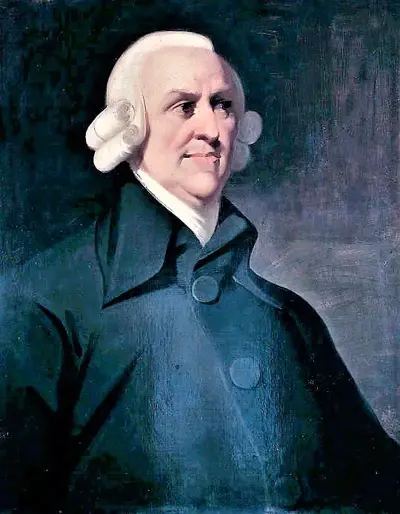
Adam Smith FRSA was a Scottish economist, philosopher as well as a moral philosopher, a pioneer of political economy, and a key figure during the Scottish Enlightenment, also known as ''The Father of Economics'' or ''The Father of Capitalism''. Smith wrote two classic works, The Theory of Moral Sentiments (1759) and An Inquiry into the Nature and Causes of the Wealth of Nations (1776). The latter, often abbreviated as The Wealth of Nations, is considered his magnum opus and the first modern work of economics. In his work, Adam Smith introduced his theory of absolute advantage.
