Eleanor Roosevelt Quotes
Land use is becoming more and more a general national interest and should be as much a study in the cities as in the country. For with the proper use of land, many of our greatest troubles—dust storms, floods, over-production of this and that, would at least be measurably controlled.
Eleanor Roosevelt, 1884-1962, First Lady (Franklin Delano Roosevelt), U. S. Delegate to the United Nations, Column, My Day, February 27,1936
Sourced by: Eigen's Political and Historical Quotations


The emergency was what was called the “Dust Bow” which was a period of severe dust storms causing major ecological and agricultural damage to American and Canadian prairie lands in the 1930s. Over 350,000 people left the Great Plains. The phenomenon was caused by severe drought combined with a failure to apply dry land farming methods to prevent wind erosion. What makes this quotation important is that it illustrates a remarkable practice of Mrs. Roosevelt that no other first lady as every done. Here the First Lady of a sitting President was overtly whipping up public opinion to complain that the government, led by her husband, was doing nothing to cope with a national emergency. This was very common and Mrs. Roosevelt was way out ahead of the President and his administration on most issues of the day. The President seemed to like the idea and it may have been one of the great public strategies of a Presidency. The First Lady would publicly advocate major reforms. The President could then observe the public reaction, judge the newspaper and pundit pronouncements, see how different special interests reacted. Then he could decide to embrace the reform or ignore it saying that it was just the opinion of his very independent wife. FDR had a very strong ego and had no problem with his wife publicly criticizing him.

Withdrawal meant not allowing certain public land to be sold or allotted to homesteading, commercial development, mining, industrial, ranching, or agricultural use. It was reserved as wilderness areas and/or national parks or forests.


This statement of the problem was so eloquent and universal that it is even used a century later. For example it was quoted by James Inhofe, on his Senate Speech, October 4, 2004.

This statement was quite controversial when it was published and remains so. Many libertarians and private sector enthusiasts see giving this power to government is too much and erodes the sanctity of private property. Nonetheless, most local and state government in America subscribes to this point of view thus allowing zoning, city planning, condemnation of private property for public use and the like. In 1976 when it was promulgated, President Ronald Reagan discussed it in his weekly radio address.


Roosevelt thought like Jefferson that it was not desirable to have a large proportion of the population residing in cities, and one of the more successful aspects of the New Deal with the improvement of conditions in rural America. Despite that, the trend to the cities was inexorable in America with the rest of the world following that trend.


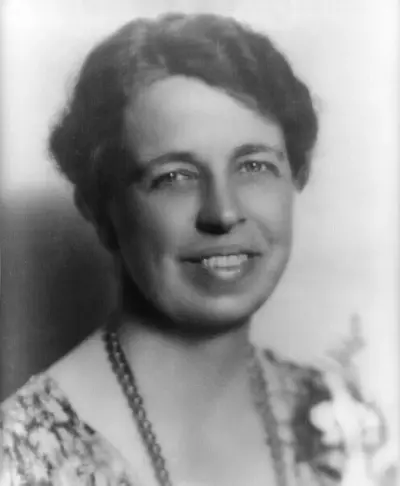
Anna Eleanor Roosevelt was an American political figure, diplomat and activist. She served as the First Lady of the United States from March 4, 1933, to April 12, 1945, during her husband President Franklin D. Roosevelt's four terms in office, making her the longest-serving First Lady of the United States. Roosevelt served as United States Delegate to the United Nations General Assembly from 1945 to 1952. President Harry S. Truman later called her the "First Lady of the World" in tribute to her human rights achievements.
