Robert Gordon Quotes
They do not even believe in God any more and … want to turn everything upside down in the apparent beautiful name of freedom and equality.
At the time, Capetown was under the control of the Dutch East India Company which had recruited Gordon from Scotland. There was a wave of liberality following the Enlightenment, the American Revolution, and the very vocal English, anti-slavery, reformers. The Dutch were concerned mainly with making money, and that they thought that meant stability and the status quo. Gordon was their strong spokesman on this. Like American Southern slave owners, Gordon read the Bible as God endorsing slavery and the inferiority of Blacks. Thus, reformers did not "believe in God any more".
Robert Gordon, 1743-1795, Scottish Military Commander of Capetown, South Africa, Comment about English reformers who wanted citizenship for Blacks and equality of treatement, 1795
Sourced by: Eigen's Political and Historical Quotations


The power structure of England and the English administrators of South Africa were strong advocates of racial equality at the beginning of the 19th century. They insisted on equal administration of law. However the Boer white population could think of nothing more absurd. In a sense the Boers were much like the Southern Whites at the same time. The South African government however could not enforce its equality policies in the rural area – the majority of South Africa at the time. When democracy and self rule came to South Africa, the racially moderating force of the English was minimized and the majority of South Africans wanted a racially segregated society. Apartheid resulted.
There was continuing tension between England, the Colonial Governors of South Africa and the Boers. Immigrant settlers to South Africa from Holland. The Boers were very uneducated and not steeped in democratic government. They wanted to enslave and sieze the land of the Black residents. Under English law, the Blacks were also English subjects. The Boers insisted that any interference in their persecution and enslavery of the Blacks was oppression just as the Southern American Whites saw Reconstruction defense of the Blacks as oppression to them. The classic question is: “Is it oppression to stop people from opressiong others?”


The White Africaners were attacking the Blacks to force them off their land so the Afrkaners could take over. The country was under British rule and the unarmed Blacks were being slaughtered by the Afrikaners who were British Subjects. Eventually the Boer War set the English against the Afrikaners. See {583902} for a related quotation.

White Africaners were slaughtering Blacks to appropriate their land in violation of English law. See {583901} for a related quotation.
When the British first colonized South Africa, the area they used was akmost uninhabited or very sparcely so. However, some Black tribes (including the Zulus) were moving from the north and themselves were colonizing or annexing the areas to their kingdom. The British were most interested in Trading so did not have large land asperations. The Dutch white Boer Africanners, in contrast, wanted to farm the lands and use the range for their cattle. They wanted the land. The English policy was that there would be friendly relations with the Black tribes surrounding their Cape Colony and no one should take their land. However the Boers started attacking the Black areas and seizing their farms and villages. At first, the English assumed that the Blacks would easily be able to ward off the invasion as the Afrikanners had no professional troops like the British. However, the neighboring tribes were not very warlike or good fighters. They were being overrun by the Zulus coming from the North and the Boers from the South. The British Government had a real problem in that they would have to have British soldiers fight the white Afrikanners if they wanted to stop the illegal white invasions. This was the root of the Boer War where the British would be fully at war with the Africanners.

The Diggers were a religious-economic movement that even today would be considered very radical. They advocated the right of the poor to go onto public lands and farm them—thus the name “Diggers.” Beyond their opposition to the private ownership of land to the exclusion of the poor, Winstanley and the Diggers promulgated another very modern doctrine: That the poor should take the responsibility and have the right to determine how the society should provide for the poor. A version of this became one of the Mottos of the Poverty Program of 1964. See {616966}.


the Dutch monarchy supported by England The French fear of course was that the revolutionary fervor spreading to the bourgeois could easily spread to France, and that is exactly what happened 4 years later. See {639769} for more of his view on the Dutch revolutionary spirit that might infect France.
The revolutionists were disorganized and unfocused after the Coup that brought them to power. This speech provided some focus for a while. Early in his career, as a Journalist working in Leiden, Holland, he was very active and helpful to the Dutch Patriots and Revolutionaries in their takeover of the government. He helped draft the New Dutch Constitution and participated in most of the new governments conventions.


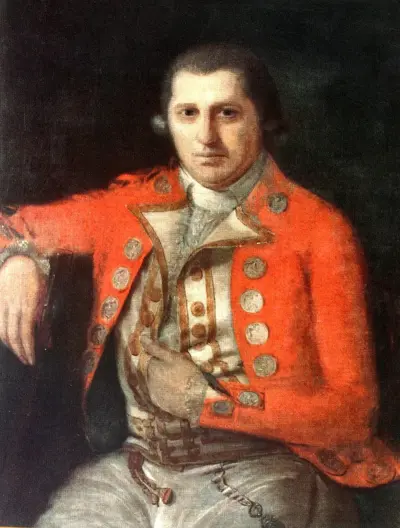
Robert Jacob Gordon was a Dutch explorer, soldier, artist, naturalist and linguist of Scottish descent.
