Benjamin Franklin Quotes
The Riches of a Country are to be valued by the Quantity of Labour its Inhabitants are able to purchase, and not by the Quantity of Silver and Gold they possess
Benjamin Franklin, 1706-1790, Governor of Pennsylvania, Member of the Continental Congress & the Constitutional Convention, Governor of Pennsylvania, President of the Pennsylvania Assembly, U.S. Minister to France, Postmaster General of the American Colonies, A Modest Enquiry into the Nature, and Necessity of a Paper-Currency, 1729
Sourced by: Eigen's Political and Historical Quotations

Note that although the industrial revolution was beginning, the value of factories, inventory, machines, and raw materials were not yet recognized by some of the leading intellectuals of America. The perspective was totally agricultural.


Economists they world over have differed as to how critical it was to have a money supply that is based on a gold standard or other precious metal. United States history has had a dispute over whether the money should be backed by gold or silver. Finally, under the Richard M. Nixon administration, the United States went off the gold standard and American money ever since is only backed by the ‘full faith and credit’ of the United States. Some politicians like Paul believe this is a poor policy since it allows governments to control their own money supply irrespective of their gold or silver holdings. Paul goes further than most and sees freedom itself dependent on a precious metal standard. Most politicians disagree.


Harvey was one of those who argued that silver and not gold should be the basis of American money. The country was growing and the amount of gold was relatively fixed; therefore money was scarce and many believed the English and American financiers were hording gold deliberately. The final solution was not a gold standard or a silver standard but what we have today—a currency backed only by the full faith and credit of the U. S.


He was asking for permission to issue more paper currency.


There has always been a fear of inflation and currency debasement by governments. Since ancient times, rulers issued coins and when they were made of cheap metals like copper or iron, the ruler could mint as much as he wanted and when he did so the value went down. By using only precious metals, gold and silver, for coins, there would be a natural restraint on government. Garfield was one of those who believed that we should always have money of gold and silver. The United States would use that principle for the next century even backing its paper money with gold and silver. In the Nixon administration the United States abandoned the gold standard. Today, it is the ability of a country to produce things that maintains value of paper money which has been supplanted in many cases by electronic money.


This view that the more people a country has, the richer it is, has gone hand in hand with the notion that a large population will assure a nation of extensive military prowess. However, both of these are now known to be false. The most heavily populated nations are among the poorest, and military prowess is more a function of the training of troops and the modern tools and weapons. Tiny Israel has demonstrated that many times since its origin. It has been attacked over and over by several nations at a time. Despite the fact that Israel was vastly outnumbered by enemy troops and weapons like tanks and planes, Israel has repeatedly demolished the more populous enemies. The world, observing this, no longer emphasizes trying to build a large manpower pool as it does not help militarily and it makes full employment very difficult.

“Laid up” means “saved”. “Commutable”means fungible—gold and silver can buy anything else.

This quotation was particularly interesting for Americans of the early 21st century by which time, the United States had become the greatest debtor nation in the world.
This is an excellent historical example of how damaging it can be for a country if its leaders do not understand the technicalities of economics and currency manipulation.


The alternative would have been for the colonies to borrow English money at high interest rates and use that. Or use money from private banks (which occurred later.) Many conservatives are today a little shocked that some of the American Colonies just printed money with no backing but it worked—at least at the local level. A Boston Bank for example, would take a large commission for a Bostonian to convert Pennsylvania money into Massachusetts money. So it was not a very good system for trade between colonies and International trade. But English money was used for that. The colonists pragmatically got the “best of both worlds” and paid as little interest as they needed to. This system is essentially what we use today on a national scale with no gold or silver backing of the money.


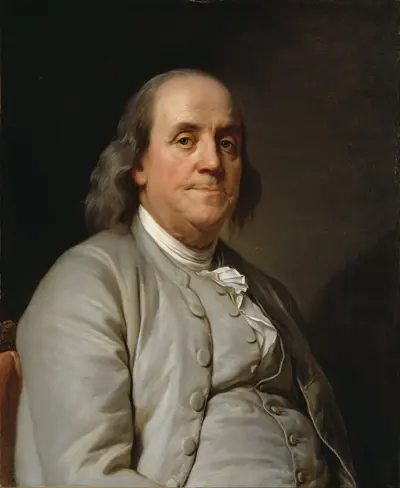
Benjamin Franklin FRS FRSA FRSE was one of the Founding Fathers of the United States. A polymath, he was a leading writer, printer, political philosopher, politician, Freemason, postmaster, scientist, inventor, humorist, civic activist, statesman, and diplomat. As a scientist, he was a major figure in the American Enlightenment and the history of physics for his discoveries and theories regarding electricity. As an inventor, he is known for the lightning rod, bifocals, and the Franklin stove, among other inventions. He founded many civic organizations, including the Library Company, Philadelphia's first fire department, and the University of Pennsylvania.
