David Petraeus Quotes
The president and I sat down in the Oval Office, and he expressed very clearly that what he wants from me is my best professional military advice.
Petraeus, David H. "Testimony Before the Senate Armed Services Committee." United States Senate, 29 Jun. 2010.


The President told McNamara that if the administration does not send the troops the Generals want, they will be blamed for any military failures that occur. If they do send all the troops that the Joint Chiefs wanted, they would be going far beyond the limits that the Defense Secretary recommended and the President would have preferred. JBJ felt he really had no political choice. He authorized the wanted troops further escalating the war. See his special assistant’s question about that decision in {617151}.

FBI Director James Comey had testified that in his single one-on-one meeting with President Donald Trump, the President told him to cease the FBI investigation of his National Security Director. Trump however claimed that he was not giving Comy an order or instruction but was just making an informal suggestion. Trump then fired Comey who did not terminate the investigation and the National Security Director was found to have committed several felonies and turned states evidence and then pled guilty to one. Some accused President trump of trying to obstruct justice but the President claimed that he had just made a suggestion to Director Comey and he fired him for other reasons.


Although the two men differed on a very important issue, each admired the other and acquitted themselves politely throughout. Congress explicitly gave the President the powers that he had exercised and won the dispute. But Dixon had also won, and upheld the law as it existed until it was changed.

George Washington had been appointed by the Continental Congress as Commander in Chief of the Continental Army but was politic about keeping Congress informed and not appear to be usurping authority. He asked Adams for an opinion of whether his authority reached beyond Boston to include the defense of New York City. Adams had been a member of the Congress that appointed Washington. Adams reply has been used as precedent for the broad authority of the President as Commander in Chief by those claiming broad Presidential power since.

This seemingly prosaic quotation is one of the most significant quotations in history. At the outbreak of the Civil War, the telegraph was rapidly developing as a communications technology. One of Lincoln’s greatest achievements was the appreciation of the new technology and the deployment of it to gain an immense strategic advantage which was a major factor in all warfare thereafter. Lincoln placed ALL telegraphy of the North under the control of the military. He then had a telegraph terminal installed in the War Department right next to the White House. He would spend many hours in the Telegraph Room reading dispatches as they were coming in. To the distress of some of his military commanders, the Commander in Chief actually, for the first time in history, received virtually real time intelligence about a battle, and issued orders to the commanders in the field in real time. The quotation is one of the early examples. Ironically, Lincoln had more real time battlefields information in the Civil War than most of our Presidents did until the Vietnam War when digital, radio communications were exploited for the purpose.

He lost the vote on this issue, and the Congress created the first committee to investigate and oversee military affairs.

He was objecting to the current crop of senior military officer who have little experience in fighting and much in academic, strategic and technical training. Many however see him as a dinosaur who does not realized the complex nature of the modern military missions. In general, we have won almost all of our fighting battles but often failed in our maintaining civil society, occupation, nation building, military procurement, preventing sexual assault of our own troops by our own soldiers, assuring mental health of our soldiers. Hackworth, detractors argue, wants to change what already works and ignore what does not.

The only soldier ever so honored


On military or foreign policy matters his view was that presidents ought not to rule anything in or out so that he/she can keep all the options open and not reduce future flexibility.


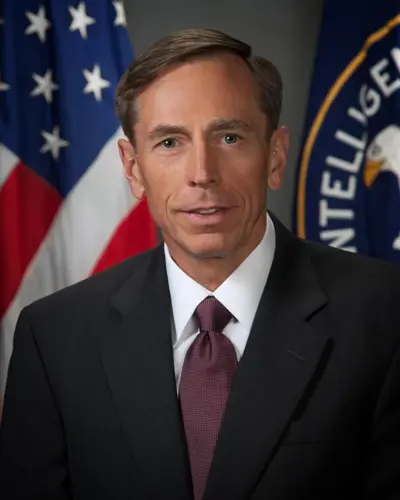
David Howell Petraeus AO, MSC is a retired United States Army general and public official. He served as Director of the Central Intelligence Agency from September 6, 2011, until his resignation on November 9, 2012. Prior to his assuming the directorship of the CIA, Petraeus served 37 years in the United States Army. His last assignments in the Army were as commander of the International Security Assistance Force (ISAF) and commander, U.S. Forces – Afghanistan (USFOR-A) from July 4, 2010, to July 18, 2011. His other four-star assignments include serving as the 10th commander, U.S. Central Command (USCENTCOM) from October 13, 2008, to June 30, 2010, and as commanding general, Multi-National Force – Iraq (MNF-I) from February 10, 2007, to September 16, 2008. As commander of MNF-I, Petraeus oversaw all coalition forces in Iraq.
