James R. Clapper Quotes
In my tenure I had three one-on-one meetings in the Oval Office with the President, and I can assure you that you remember every word of those meetings. Abd if the President indicates what he would like or prefer, you do not take that as optional.
FBI Director James Comey had testified that in his single one-on-one meeting with President Donald Trump, the President told him to cease the FBI investigation of his National Security Director. Trump however claimed that he was not giving Comy an order or instruction but was just making an informal suggestion. Trump then fired Comey who did not terminate the investigation and the National Security Director was found to have committed several felonies and turned states evidence and then pled guilty to one. Some accused President trump of trying to obstruct justice but the President claimed that he had just made a suggestion to Director Comey and he fired him for other reasons.
James R. Clapper, Interview with Don Lemon, CNN, December 11, 2017
Sourced by: Eigen's Political and Historical Quotations


There have been many power struggles between the Legislative and Executive branches, but one of the more humorous began on August 27, 1906. President Theodore Roosevelt directed the Public Printer to observe a new orthographic convention designed to simplify the spelling of English. A furor broke out as Congress fought against such a radical departure The President was defeated and so was "simplified spelling."


In 1933 the incoming President, Franklin Delano Roosevelt, personally took charge of the U. S. delegation at the World Disarmament Conference in Geneva, much to the disappointment of professional diplomats at the State Department:


This quotation was an attack on President George W. Bush who had argued to a nation hostile about the Iraq War that the decision on whether to continue the war should be determined in large part by the report that was to be given by the commander of our forces In Iraq, General David Petraeus. He reported that he thought we should give the situation some more time and effort, and that was the policy decision. Clark and others thought this was not fair to Petraeus whose job it was not to make the policy but to implement it. It was perhaps the only time in history where a President abdicated a major war policy decision to a field officer. The President even argued to Congress that they should all wait for the General to return to Washington. He argued that he made the decision; he just wanted to hear the General’s recommendation. Most believed that he could have obtained that without the General returning to Washington to talk to Congress and the American people.

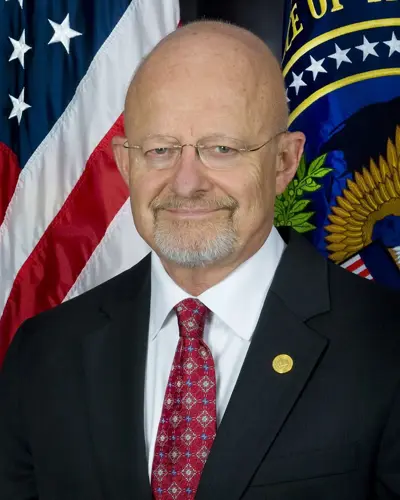
James Robert Clapper Jr. is a retired lieutenant general in the United States Air Force and is the former Director of National Intelligence. Clapper has held several key positions within the United States Intelligence Community. He served as director of the Defense Intelligence Agency (DIA) from 1992 until 1995. He was the first director of defense intelligence within the Office of the Director of National Intelligence and simultaneously the Under Secretary of Defense for Intelligence. He served as the director of the National Geospatial-Intelligence Agency (NGA) from September 2001 until June 2006.
