Andrew Jackson Quotes
The power which the General Government would acquire within the several States by becoming the principal stock-holder in corporations, controlling every canal and each 60 or 100 miles of every important road, and giving a proportionate vote in all their elections, is almost inconceivable, and in my view dangerous to the liberties of the people.
The construction and operation of Federal lighthouses and Post Office facilities was accepted, but at the time there were no Federal roads or canals. Some thought that the development of these would be good for the economic development of the country. Jackson and most other politicians could not even conceive of such a thing. However, creative legislators of future generations would create a legal framework for having private, local, state and Federal roads and canals all coexisting. This quotation also dramatically illustrates the problem the Federal Courts would have later when the Constitutionality of Federal Regulations of Billboards on Federal Highways would arise. Not only had the Founding Fathers never conceived of Federal roads, but they never imagined billboards. Yet the Supreme Court had to determine the intent of the Framers regarding billboards on Federal roads.
Andrew Jackson, 1767-1845, 7th President of the United States (Democrat, TN), Second State of the Union Address, December 6, 1830
Sourced by: Eigen's Political and Historical Quotations

The Chief Justice refused to accept the previously established legal precedents of other states which would limit considerably the right of the state to regulate corporations. As a result Wisconsin became one of America’s pioneers in regulating corporations which over 25 years later, Theodore Roosevelt was to do for the nation as a whole. The phrase “empire within an empire,” the translation of the Latin that Ryan used, has often been quoted to describe the power corporations had at that time.

In addition, most state and local corrupt officials are detected, and prosecuted by Federal law enforcement officials as local and sometimes state corruption involves the local and state law enforcement officials as well as others so local authorities often turn a blind eye towards corruption.

The United States is almost unique among nations in their respect. While there are Federal law enforcement officers, the number is very small. For example, the entire Federal Bureau of Investigation complement of agents is outnumbered by one of the three shifts of the New York City Police Department. The vast majority of the police officers in America are not even at the State level; it is at the local level.

England did not follow this precept but the United States did and is the only country that did. In all others, education is controlled by the national government. However, Godwin's principle of separating education from government is not maintained in all the states of America. In many, the State government leaves much of the curriculum and the operations of the school to local school boards which have a great deal of discretion. However, in most of the Southern States, the State government dominates and controls education and relatively little is left to the school boards. In some the State chooses the allowable textbooks. In those cases, Godwin's principle is violated, but in most of the North East and Midwest and some of the far West the school boards have great autonomy and Goodwin's principle is upheld. It is fascinating that the more control a particular state exercises of the schools, the poorer the performance of the schools of that state. Goodwin had a terrific insight.


President John Adams Alien and Sedition Acts were amongst the worst laws ever passed in America. It totally violated the First Amendment but at the time the Supreme Court had not ruled on the laws which prohibited criticizing the government. Ironically, it was Adams’s son, John Quincy Adams who finally led the repeal effort.


On June 12, 1789 a Senate committee proposed a federal court system for the nation. Maclay described it as:

A common modern political issue is the relative efficiency of State verses the Federal government in the spending of tax resources, but in the area of defense, it is today assumed that this is a Federal role. However, in 1814, in the midst of a war, there were those who argued for State operation of the nation's defense. See Artemas Ward for a similar view.

In 1911 the Supreme Court upheld the monopoly conviction of Standard Oil Company but held that the Sherman Antitrust Act only applied to “unreasonable” monopolies and not to monopolies in general.

The 100,000 Mormons in the Utah Territory rebelled at the hostile Federal officials coming into Utah to run things without the consent of the citizens of the territory. It was a cry for the territorial version of States’ Rights.


The Constitution was not drafted until 1787 and was ratified later. In the interim the young United States functioned under the Articles of Confederation, in a sense, our first Constitution. This clause established that the Federal Government should have the exclusive power and authority to conduct foreign affairs.

Madison was defending the proposed Constitution against a vocal minority who complained that the Federal government would be dominant over the States and the large cities. Madison pointed out that it was people who fought the Revolution and sacrificed for it, not States or political entities. The Constitution was to be for the people, not the existing governmental entities. It was for Americans and not for local politicians. The “State’s Rights faction lost the debate, and the Constitution and Bill of Rights was adopted. That is why this quotation is so important. The slavery enthusiasts, racists, and others have constantly tried to diminish the Federal supremacy even to this day.


Surprising to most Americans today, at that time, the Governors controlled the State militias, and in this case two Governors refused to make their militias available for the war effort. This experience and others led to the change which today allows the Federal Government to “call up” the National Guard of any state regardless of the desire of the State Governor.

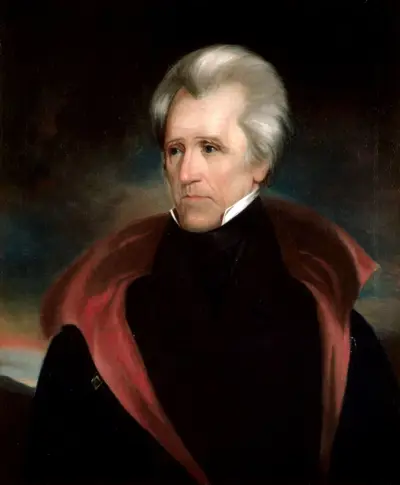
Andrew Jackson was an American lawyer, soldier, and statesman who served as the seventh president of the United States from 1829 to 1837. Before being elected to the presidency, Jackson gained fame as a general in the United States Army and served in both houses of the U.S. Congress. An expansionist president, Jackson sought to advance the rights of the "common man" against a "corrupt aristocracy" and to preserve the Union.
