Stephen Douglas Quotes
The people of every separate political community (dependent Colonies, Provinces, and Territories as well as sovereign States) have an inalienable right to govern themselves in respect to their internal polity.
Stephen Douglas, 1813-1861, U. S. Congressman & U. S. Senator (Democrat, IL), “The Dividing Line Between Federal and Local Authority: Popular Sovereignty in the Territories,” Harpers Magazine, September 1859
Sourced by: Eigen's Political and Historical Quotations


Madison was defending the proposed Constitution against a vocal minority who complained that the Federal government would be dominant over the States and the large cities. Madison pointed out that it was people who fought the Revolution and sacrificed for it, not States or political entities. The Constitution was to be for the people, not the existing governmental entities. It was for Americans and not for local politicians. The “State’s Rights faction lost the debate, and the Constitution and Bill of Rights was adopted. That is why this quotation is so important. The slavery enthusiasts, racists, and others have constantly tried to diminish the Federal supremacy even to this day.


5th Earl of Rosebery

Ironically, many Republican leaders give lip service to decentralized government but they fight hard for centralized national government making. Many want Congress to make laws governing abortion and other family planning techniques. Some want the state to decide, but almost no Republicans want to leave these personal decisions to the local government much less the family and women involved. In business regulation as well, republican fight tooth and nail to have Federal legislation prempt state and local government about tort liability for defective products, and they always prefer that the Federal SEC make all the rules and regulations about selling stocks and bonds and do not want state or local government to “interfere”. Likewise, they have emasculated the state governments when it comes to authority over the state militias where virtually all the controls and promotions are decided by Congress and the Department of Defense and not by Governors or local politicians. Ther are many other examples. In most of the solid Republican Southern States, the local school boards cannot even select the textbooks that schools will use and the Republicans centralize this with the State government and state legislatures which they control. Democrats also are generally opposed to decentralization except for large cities having control along with the Federal government but otherwise they too do not want decentralization. For national political parties, what is the point of winning national elections of the big decisions are made locally?


McKinley was then Secretary of War and Taft was Chairman of the Commission on the Philippines.


From the very beginning of the country, some states reserved the job of policing the state to the state as opposed to the Federal Government and would not countenance federal police, and there really were not any until the FBI was created in the 20th century. Still unlike any other country, the Federal government has minimal policing power. The FBI is very small—so small that it is smaller then one of the three shifts of the New York City police department.


During the early days of the American independence movement, many were preoccupied with the philosophical and theological issues of whether the Almighty approved of monarchy or not. Parker urged concentration on assuring independence first.

Some in the military and state department were distressed by this writing. England was our major WWII ally. We were fighting, side by side with soldiers of many of the colonies of the British Empire. Some nationalists in India were urging non-cooperation in the Allied war effort. Most American leaders adopted the policy of holding our differences with our allies (England, China & Russia) until after the war was won. However, Mrs. Roosevelt, was more outspoken than most other public officials.


Although opposed to monarchy himself, Langdon argued that a people had a right to select monarchical government if they chose. See {634001} for Rev. Dan Foster’s similar argument at in that period.


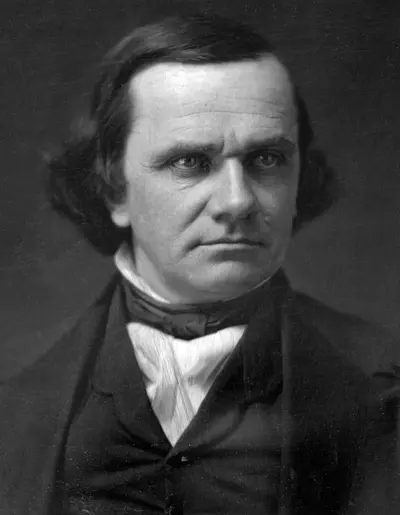
Stephen Arnold Douglas was an American politician and lawyer from Illinois. He was one of two Democratic Party nominees for president in the 1860 presidential election, which was won by Republican Abraham Lincoln. Douglas had previously defeated Lincoln in the 1858 United States Senate election in Illinois, known for the Lincoln–Douglas debates. During the 1850s, Douglas was one of the foremost advocates of popular sovereignty, which held that each territory should be allowed to determine whether to permit slavery within its borders. Douglas was nicknamed the "Little Giant" and "Stevie D" because he was short in physical stature but a forceful and dominant figure in politics.
