William Randolph Hearst Quotes
Any railroad corporation has infinitely more influence in any department of government than all the human beings that live in the territory that the railroad traverses.
William Randolph Hearst, 1863-1951, U.S. Congressman (Democrat, NY), Founder, Independence League Party, Journalist and publisher, Speech, Independence League Conference, Albany, NY, February 28, 1906
Sourced by: Eigen's Political and Historical Quotations


He made this quotation when he was a member of the Wisconsin State legislator. He was describing the influence and interaction that corporations had with the Wisconsin state legislative process.


The WWI veterans lobby was formed and they pressured Congress into authorizing a bonus of between $1 and $1.25 for each day of wartime service. However, the catch was that they would not be paid until 1945 unless they did, Hence the name for the bonus. The Bonus March on Washington would eventually march on Washington to get their pay while they were still alive. Finally, the bonuses were paid immediately after Franklin Delano Roosevelt assumed the Presidency even though he personally opposed paying it early. Congress passed the law over his veto.


The State Department has always been reluctant to have the US Government make an official condemnation of the Turkish. Prior to the end of WWI. Turkey’s Ottoman Empire controlled most of the Middle East which was discovered to be full of oil. Armenia had no oil. The State Department since then (and until the 1970s) it has made it a top priority to advocate for Standard Oil and other American oil companies with the Turks and then the Arabs regardless of the morality of the situation. Despite the fact that virtually every American leader wanted to advocate for the Armenians, the State Department held fast to not
upset Turkey about the Armenian Genocide. Cardashian was the first American who openly stated what the real motivation was. See {638251}, {620602}, {620603}, {620604}, {620605}, and {620606}


The “rebate agony” referred to a corrupt practice of the Railroads and the Large Monopolies. The railroads charged a very high rate for the transportation of important products like beef and oil. However, secretly they gave back a large percentage of the transportation rate charged to the trusts. They in turn could cut their prices and undersell all the smaller competitors who were paying “full freight” and could not afford to match the lower price. As soon as the smaller competitors were driven out of business in an area, the trust raised its rates even higher than they charged originally. The Railroad had made a small but reasonable profit on the freight of the trusts but they were guaranteed all their business. They also made huge profits on the higher rates that the small companies paid until those companies were driven out of business. Journalists like Ray Baker and Ida Tarbell had uncovered the rebate scheme which enabled the trusts to steal high amounts from the general public through unreasonably high prices. President Theodore Roosevelt was committed to try and regulate the railroads and not allow rebates but charge the same public rate to all with no rebates. Socialists like Sinclair, thought that this attempt would be hopeless—that the damage had already been done, and the trusts now had so much money that they could buy state legislatures and many in Congress to preserve their dominance.


In general this is true when the public is aware and focused on an issue. However, most of the work of Congress is unknown to most voters and it is there that the money is so influential.


Drafted by their presidential candidate, Robert M. La Follette


Samuel Langhorne Clemens, 1835-1910. Even in a democracy, governments often enact laws that the public disapproves of and fails to enact others that the public wants. Most taxes are examples of the former; gun control legislation, of the latter.
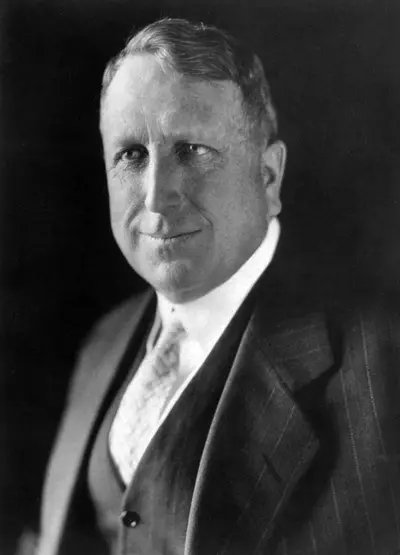
William Randolph Hearst Sr. was an American businessman, newspaper publisher, and politician known for developing the nation's largest newspaper chain and media company, Hearst Communications. His flamboyant methods of yellow journalism influenced the nation's popular media by emphasizing sensationalism and human interest stories. Hearst entered the publishing business in 1887 with Mitchell Trubitt after being given control of The San Francisco Examiner by his wealthy father, Senator George Hearst.
