Arthur M. Schlesinger Jr. Quotes
Our whole history tells us that the national government has been far less corrupt and incompetent than state and local government … Time and time again the federal government has had to rescue people from the states and local governments. If we left it to the states, we would still have slavery.
In addition, most state and local corrupt officials are detected, and prosecuted by Federal law enforcement officials as local and sometimes state corruption involves the local and state law enforcement officials as well as others so local authorities often turn a blind eye towards corruption.
Arthur M. Schlesinger, Jr., Historian & Presidential Advisor (Democrat), Interview, PBS The Charlie Rose Show, 1997
Sourced by: Eigen's Political and Historical Quotations


The 10th Amendment reserves powers to the states and limits the Federal Government’s powers. However, there are other clauses in the Constitution, like the Commerce Clause (Article I Section 8), which gives the Federal Government authority and control over Interstate Commerce, which in modern society permeates almost all activities of State government, The result is that the federal government / state government power division has been a political issue and not really a constitutional one. At the time Republicans advocated a literal 10th Amendment interpretation and the Democrats favored a stronger Federal Government with more authority and power as stated by the Commerce Clause. Roy had been trying to explain to his fellow Republican strategists that it is hard to attract Blacks to the remainder to the Republican Platform as long as they were insensitive to what the 10th Amendment meant to Blacks historically. The Southern states cited the 10th Amendment more than any other part of the constitution to justify their right to maintain slavery. It was the Federal Government that ended slavery. Under the rubric of the 10th Amendment the South managed to get rid of most of the racial civil rights Reconstruction reforms that were imposed by the Federal Government on the Southern States. And it was the 19th Amendment that was the authority for Segregation for 100 years. And the terrorism of the Klu Klux Klan and the lynching and terror imposed on Blacks by Southern states claiming the 10th Amendment right to do so. Finally, it was the Federal Government, overriding the 10th Amendment with the Commerce Clause and other parts of the Constitution that passed and enforced the Civil Rights Act, the Voting Rights Act, Desegregation and the end to Lynching and other Southern State-Sponsored terrorism. Blacks will not any time soon accede to having the 10th Amendment literal view of the role of government and if Republicans insist on that there would continue to be very few Black Republicans,

The United States is almost unique among nations in their respect. While there are Federal law enforcement officers, the number is very small. For example, the entire Federal Bureau of Investigation complement of agents is outnumbered by one of the three shifts of the New York City Police Department. The vast majority of the police officers in America are not even at the State level; it is at the local level.


On February 11, 1790 American Quakers submitted a petition to immediately abolish the African slave trade from America. Southerners like Jackson argued that the Congress should not even “consider” such a petition or debate such as subject for if it did, that per se, would imply the possible consideration of emancipation, and if that were possible, they would be on the slippery slope toward emancipation of existing slaves which would be the end of the world as the Southern whites then knew it.


There was huge pressure on the central government to decentralize as they held all the power in Indonesian society. However, if they devolved power to the Provinces (States), many of them could be large enough and independent enough to secede and become an independent country as East Timor had done. So the Indonesian power structure bypassed the Provincial governments and devolved power directly to the local governments, none of which was independent enough to go it alone. The desired objective was met—no more secessions. However, there was no one to worry about regional and national issues and problems as the politicians who had power were all local. The country was becoming non-functional in many ways.

Historically in America, the local governments have been the most corrupt. State government somewhat less so, and the Federal Government has statistically, given the number of employees, the lowest proportion of corrupt officials. Even in modern times, there are many local jurisdictions where bribes of building inspectors, zoning officials, health inspectors and police are still common. At the end of the 20th century, for example, every single Kentucky County Commissioners but one was indicted and convicted for accepting bribes and kickbacks. At the federal level, there is much moral corruption with Presidents and members of Congress taking "campaigh contributions" in exchange for access and the ability to influence and even write legislation. The members of Congress wrote the laws so activities that many peopke would see as corrupt was actually legal. Even when the campaign conributions were used to pay "salaries" to the relatives of the member of Congress or he/she added the money to his/her retirement fund.


At the time most of the members of Congress were worried about the “General Government”—their term for the Federal Government---than they were, the state governments from which they had come and were in their minds represented. If would be almost a century before it was generally accepted that the States themselves must follow the Constitution and its amendments. Madison was way ahead of his time, and saw that rights must be protected from all levels of government.


A Bill of Rights was needed Left before it ended.


England did not follow this precept but the United States did and is the only country that did. In all others, education is controlled by the national government. However, Godwin's principle of separating education from government is not maintained in all the states of America. In many, the State government leaves much of the curriculum and the operations of the school to local school boards which have a great deal of discretion. However, in most of the Southern States, the State government dominates and controls education and relatively little is left to the school boards. In some the State chooses the allowable textbooks. In those cases, Godwin's principle is violated, but in most of the North East and Midwest and some of the far West the school boards have great autonomy and Goodwin's principle is upheld. It is fascinating that the more control a particular state exercises of the schools, the poorer the performance of the schools of that state. Goodwin had a terrific insight.

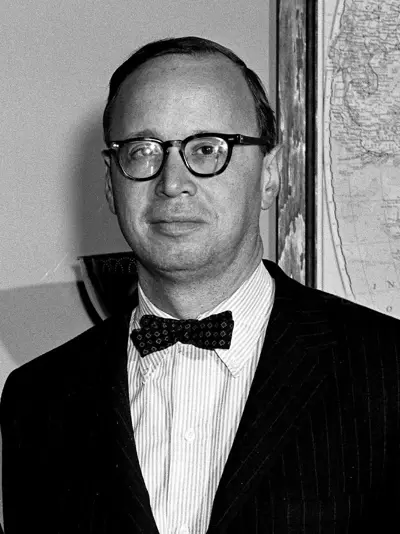
Arthur Meier Schlesinger Jr. was an American historian, social critic, and public intellectual. The son of the influential historian Arthur M. Schlesinger Sr. and a specialist in American history, much of Schlesinger's work explored the history of 20th-century American liberalism. In particular, his work focused on leaders such as Harry S. Truman, Franklin D. Roosevelt, John F. Kennedy, and Robert F. Kennedy. In the 1952 and 1956 presidential campaigns, he was a primary speechwriter and adviser to the Democratic presidential nominee, Adlai Stevenson II. Schlesinger served as special assistant and "court historian" to President Kennedy from 1961 to 1963. He wrote a detailed account of the Kennedy administration, from the 1960 presidential campaign to the president's state funeral, titled A Thousand Days: John F. Kennedy in the White House, which won the 1966 Pulitzer Prize for Biography or Autobiography.
