John Foxe Quotes
The pope being informed of the great increase of Protestantism, in the year 1542 sent inquisitors to Venice to make an inquiry into the matter, and apprehend such as they might deem obnoxious persons.
Foxe, John. Foxe's Book of Martyrs. Edited by William Byron Forbush, John C. Winston Co., 1926.

The King Outlawed Protestant Worship.
The Protestants had been given the right to practice their religion free from harm by the King’s grandfather. See {617664}. The inter-religious animosity continued and the Catholics again tried to make France an exclusively Catholic country.

While the Visigoths had some very advanced legal principles, this law, quoted in its entirety is typical of the nations that were part of the Catholic world. The church and its doctrines were immune from any possible criticism, explicit or implicit. This is the most formalized and sophisticated compendium of laws of the so-called “barbaric peoples” of Europe. The compilation was in many ways a documentation of the traditional laws of the Visigoths that had evolved over hundreds of years.


This was the beginning of the inquisition.

It was not until 1780 that Catholics were allowed to even be members of Town Corporations.
While Christianity and other religious groups were the inventors of these particular devices of compulsion of conscience, in modern times, but almost all other groups have given up torture and execution as a means of compelling religious obedience, many Muslim nations, even in modern times use the machine gun or the headman’s sword or other barbaric means to punish heretics. At the beginning of the third millennium, Islamic theocracies such as Iran, commonly executed followers of the Bhai and other non-Islamic religions. Many historians feel that the Muslims learned from the Christians such barbarity, but maintained the practices long after the questions had abandoned them. In addition, Shiite and Sunni Muslims have been butchering each other for centuries in dominate Islam nations and trying to force their interpretation of Islam in each other. The practice still continues.

Admiral Coligny was a leading French Protestant. He was murdered along with 50,000 Protestants by the French Catholics in what has come to be known as Massacre of Saint Bartholomew. Earlier in his career Pius V had been the an inquisitor or the Inquisition and was appointed “Inquisitor General For All Christendom,” so he had an anti-Protestant background. Incredibly enough, he was beatified and canonized a saint despite—some say because of—his participation in and encouragement murders of non-Catholics and even Catholics who happened to dissent on some aspect of theology. It is not clear whether the Pope knew in advance of the planned massacre or whether he or his representatives had any part in the planning of it. Since the end of the Second World War, Popes have been in the forefront of protest and moral condemnation of religious or ethnic atrocities, and it is hard for most of us to conceive that a Pope could countenance the murder of 50,000 souls by his faithful followers.
In this speech, and in {634756}, he argued against unification to a public that was mostly opposed. The leadership was interested because they were facing the Muslim Ottoman Turks who were getting more powerful each day. The Eastern Emperor, Constantine XI, more of a soldier and politician than a cleric, wanted the military strength of the Franks and other Western European Christian armies to help protect the Eastern Empire and Byzantium and were willing to reunite under the Pope to get it. Gennadios and his faction were not. They prevailed and the next year, the Muslims conquered Byzantium which had little help from the armies of the Western Roman Empire.

The origins of the extreme religious intolerance of Spain occurred centuries before the excesses of the Spanish Inquisition. Before the Conference the Visigoths and their king had been converted to Christianity but not all cared for the new religion.


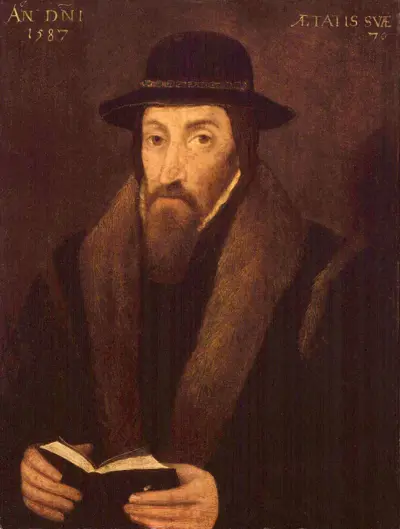
John Foxe, an English historian and martyrologist, was the author of Actes and Monuments (otherwise Foxe's Book of Martyrs), telling of Christian martyrs throughout Western history, but particularly the sufferings of English Protestants and proto-Protestants from the 14th century and in the reign of Mary I. The book was widely owned and read by English Puritans and helped to mould British opinion on the Catholic Church for several centuries.
