William Tecumseh Sherman Quotes
The idea of making them take the oath is absurd.
of allegiance to the U.S. There were a number of “Copperheads” –Southern sympathizers—in the North, especially those areas that were near borders with Southern States. Some patriots proposed requiring everyone to take an oath—a solution that tends often to be suggested in times of war and strife, but really doesn’t do any good. The real traitors just falsely take the other; others who refuse, do so on principle and are rarely dangerous. Few public men had had the courage to call the process of requiring loyalty oaths absurd as Sherman did in the Civil War. In almost every era of war—cold or hot—there are some people who call for requiring more loyalty oaths and relatively few like Sherman who will publicly admit its futility.
William Tecumseh Sherman, 1820-1891, General of the Army & Indian Peace Commissioner, July 31, 1862
Sourced by: Eigen's Political and Historical Quotations


This quotation illustrates a scientific principle that is at the heart of several political issues. Specifically the debate over whether creationism should be taught in science classes along with evolution. The major reason that almost all serious scientists (religious and secular both) oppose teaching creationism is that it is not a “falsifiable” set of statements—that is there is no way to prove it or disprove it. There are scientific statements that can be proved or disproved but have not yet been so. To be a scientific statement, it must be falsifiable—logically provable or disprovable. And this is the logic which the Federal Courts have used in ruling that creationism may not be taught in science classes in public schools. This quotation, Pauli is saying that the paper is not falsifiable—it cannot be proved and cannot be refuted. As such it is not scientific and belongs in the realm of philosophy, literature, theology, or other disciplines, but not science. An example of non-falsifiable statements are: “Blue is the most attractive color.”; “Freedom is essential to capitalism”; “Monarchy is more efficient than theocracy”.


For the required Oath, see {623308} . There were several to the amnesty. These included graduates of West Point and the Naval Academy who had joined the rebellion, senior officers and officials of the Confederacy, those who were accused of war crimes and abusing Union prisoners of war, persons who went abroad to help the Confederacy, and Northerners who had gone South to aid the rebellion. Many scholars think that although Lincoln had expressed his desire to provide an amnesty after the war was over, he probably would have been more lenient than Johnson who exempted many on the Southern side—especially the leaders. Ironically, Johnson was a Southerner but was personally, morally outraged at taking up arms against the United States and in that sense was much more of a hawk than Lincoln and many of the radical Republicans even. However, he was an inveterate racist and resisted most of the attempts to implement equality during the Reconstruction. Many argue that but for Johnson, Reconstruction might have been much more successful. It was easy for Southerners to resist equal rights for Blacks when they knew that the President was also opposed to measures to produce equality.
This oath was required of Southern Rebels who wanted obtain amnesty from treason which they had committed by engaging in the Civil War. See {623307} for the Presidential Proclamation.


There was a legal requirement that all cadidates for the parliament had to sign before the election an oath swearing to take their seat if elected to close off the possibility that some would cripple the parliament by winning but not taking their seats. De Valera wanted to run, and fully intended to take his seat, but had promised to sign no oaths about the parliament elections. On the last day possible, he went to the election clerk who gave him a piece of paper with the oath printed on the top and below it, the lines for candidate signatures. De Valera took a blank piece of paper and covered the oath but leaving the signature line exposed. He then signed the line and made sure that the clerk would remember that he has not signed an oath, but had signed a blank piece of paper where the oath could not be seen. To him this was a very important distinction but if failed to convince most other Irishmen.


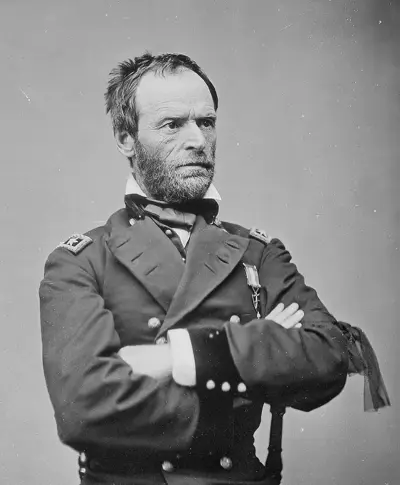
William Tecumseh Sherman was an American soldier, businessman, educator, and author. He served as a general in the Union Army during the American Civil War (1861–1865), receiving recognition for his command of military strategy as well as criticism for the harshness of the scorched earth policies he implemented in conducting total war against the Confederate States. British military theorist and historian B. H. Liddell Hart declared that Sherman was "the first modern general".
