Theodore Roosevelt Quotes
To announce there must be no criticism of the president or that we are to stand with the president, right or wrong, is not only unpatriotic and servile, but is morally treasonable to the American public.
Roosevelt, Theodore. "Sedition, a Free Press, and Personal Rule." The Kansas City Star, 7 May 1918.


Miles, a hero of the Indian Campaigns (although he led the atrocities at the massacre at Wounded Knee) and then the leading military figure in America was an opponent of the policies of the new young President and had political aspirations of his own for the Presidency. Miles’ opinions were printed in the press. He maintained that he was not speaking as the Commanding General of the Army but personally as a citizen. The President surprised almost all by publicly scolding and reprimanding Miles when he next came to the White House. Five days later Roosevelt made the reprimand official, effectively ending Miles career. The issue of when senior military officers can criticize the administration has been debated ever since. Roosevelt was also a war hero himself, and although the military was shocked by such “savage” treatment of a senior officer, the President had public opinion on his side. Every decade or so there is a military official who does not care for the administration’s policies and expresses himself publicly. President Truman’s firing to General Douglas Macarthur was the most dramatic case, but Truman was well aware of the Miles and TR precedent.

In the latter part of the 20th century and the beginning of the 21st, one of the tactics of conservatives was to accuse liberal candidates and office holders of being un-American, unpatriotic, and disloyal to the country. The tactic goes back to the beginning of the nation when Jefferson and the Democratic Republicans claimed the Federalists were un-American--monarchists and Anglophiles. In the 1950’s, Senator Joseph McCarthy attacked President Truman, Secretary of State Acheson, Secretary of the Army Stevenson and many others for “un-Americanism.” Even wounded war hero, paraplegic, Senator Max Cleland was accused by Republicans a of being unpatriotic which led to his defeat at the polls. So accusing the President of being un-American, was that unique an act even though it shocked most Americans.


There was much similarity between the methods of the Nazis in Germany and the IRA in Ireland at that time. However, their objectives and philosophies were totally different. Like the Nazis, political opponents were “traitors”.


Edward Snowden, a defense contractor and government employee, publicly revealed that the U. S. intelligence agencies were intercepting and keeping a data base of ALL telephone calls and all Internet e-mails. The government had denied that this was so, and had classified the domestic spying program as Top Secret. Snowden had signed an agreement not to reveal any classified information, and he violated the agreement. Therefore the government was trying to extradite Snowden from Russia at the time so that they could criminally prosecute him. However, there was great debate as to whether the spying on all Americans was legal and Constitutional. Many saw Snowden as a “whistleblower” and pointed out that the government which had lied wanted to prosecute Snowden for telling the truth. Fein, an attorney, was representing Snowden and his family.

Ad hominum attacks are attacks against the person—not his views or arguments against them and not even what he has allegedly done or the consequences of what he has done to others. It is direct character assassination. This is much more effective than trying to argue what wrong has been done. It has been a very common tactic of the Right Wing Republicans and the Tea Party against liberals and supporters if desegregation, and has also been used by extreme leftists in attacking powerful industrialists. When Assange published thousands of State Department cables, many of which exposed the fact that Government officials had been lying to the public and Congress while under oath, there was a massive ad hominum attack on Assange casting aspersions on any information he might claim is real, but never once denying that any of the cables were genuine. The attacks claimed that Assange’s publication would cause American agents throughout the world to be exposed and killed, but even a year after these accusations, neither the State Department nor the intelligence agencies could point to a single case where an American agent had come to harm. The embarrassment was however profound, and some governments were outraged that their confidential dealings with the United State had been exposed to public scrutiny.


This principle was incorporated into American law by the Supreme Court 1964 decision in Sullivan v. New York Times, where this argument drove the opinion.

This is an amazing speech which illustrated the best of the development and growth of Islam. Note that: The ruler who has just been given ALL secular AND religious power admits candidly that he may not be the best qualified. This would not happen for over another 1000 years and even today is very rare in any society. In addition, he invites the citizens to correct him when he is wrong. Later, Calihs would, like the Christian kings and popes claim infallibiity and kill any who suggested otherwise. And daring to correct the ruler was capital offence for most of history and is even dangerous in some Muslim countries today. Last and perhaps most amazing, the new Caliph called for an affirmative leveling of the inequality of rights and power and announces it asa one of his major responsiblities. It is this kind of vision so unheard of at the time which shows us why so many flocked to Islam at the time. From a fairness, human rights, and accoutabiity of the ruler point of view Islam was the most modern of the religions then. Tragically, other forces shaped Islam for the next 1500 years and most Muslim countries become the least modern and its rulers are least accountable to the citizenry with none of the other rights and concept of fairness that Abu Bakr and other early Islamic leaders brought.


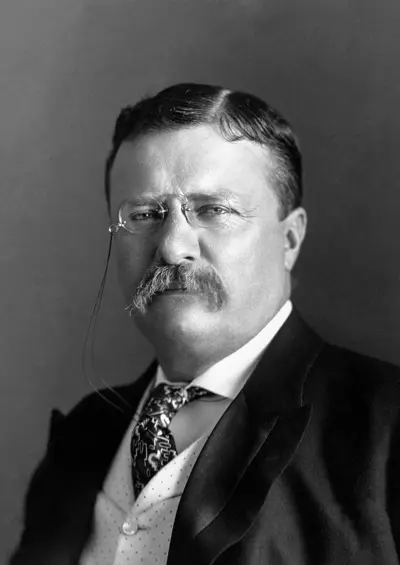
Theodore Roosevelt Jr., often referred to as Teddy or his initials T. R., was an American statesman, conservationist, naturalist, historian, and writer, who served as the 26th president of the United States from 1901 to 1909. He previously served as 33rd governor of New York from 1899 to 1900 and the 25th vice president of the United States from March to September 1901. Roosevelt emerged as a leader of the Republican Party and became a driving force for anti-trust and Progressive policies.
