Frederick Douglass Quotes
So long as my voice can be heard on this or the other side of the Atlantic, I will hold up America to the lightning scorn of moral indignation. In doing this, I shall feel myself discharging the duty of a true patriot; for he is a lover of his country who rebukes and does not excuse its sins.
Frederick Douglasss, ~1817-1895, Abolitionist & Editor, Recorder of Deeds, District of Columbia, U. S. Minister to Haiti, Speech, Market Hall, New York City, October. 22, 1847
Sourced by: Eigen's Political and Historical Quotations

Colonel Banks had given him the Regimental colors flag and urged him to take care to return it with honor. This was his famous reply. In the midst of the Battle he was hit fatally with a cannonball. A Black corporal then took up the colors and he too was killed and yet another Negro corporal took the flag and returned it after a battle where the Blacks were commended for their valor. This quotation has been quoted to military men and women throughout the world as an outstanding example of military bravery and honor..

In 2017 President Donald Trump, in resposnse to a Nazi, KKK, & White Supremicists "March" in Charlottesville, Virginia and a citizen counter protest, in whcih one of the White Supremicists ran down in a car a number of citizen protesters killing one, equated the two groups be saying that there was violence on both sides. Most of the country was outraged, and Frazier was the first member of the President's Business Advisory Council resigned in protest, making this statement. Many did so also, and Trump in a desparate effort to avoid the embarassing news each time there was anotehr resignation be a leading CEO, disbanded his 3 citizen advisorty councils.


For variations on this theme see Stephen Decatur, Meyer London, Charles Churchill and Carl Schurtz


Instead of standing and saluting as professional athletes have done for decades before games, he kneeled and refused to stand. This caused great public criticism but also some initial support. He was potentially risking his multimillion dollar salary as this technically violated his contract to avoid anything embarrassing to the team. He also donated $1 million to programs in the area that were working to enhance Black/white understanding. Even those who disagreed with his choice of protest defended his right to do so, and after the initial furor, public opinion, while not in agreement about his method, tended to support him for having the courage of his convictions and using his celebrity for a worthy cause. After sensing the public opinion, his team matches his $1 donation. Professional athletes both in the NFL and in other sports then began to do the same as a form of protest for the large, disproportionate, number of black men who were killed, mostly when unarmed, by police. The reference to the “paid leave” was the practice followed by most police departments—usually required by collective bargaining agreements with police unions—of placing police officers accused of committing violations of laws or regulations on paid administrative leave while all the investigations, hearings, and other processes . While this practice protected the rights of those police officers who were not guilty, it ended up paying brutal murders for a some time entire their case was decided or acted upon be the district attorney.


In one of the most unusual revolutions in world history, Brazil became independent from Portugal via a revolution led by the son of the Portuguese King and heir to the throne, Pedro I. The crown prince of Portugal, led Brazil in her breakaway from Portugal and by popular acclaim became Pedro I, Emperor of Brazil. He is probably the only monarch in history who was the heredity monarch of one kingdom and selected by popular acclaim to the throne of another.

In the attack on Fort Wagner, the color bearer was killed as was the Commanding Officer, Colonel Shaw. Carney raised the flag and led the men up the sand wall into the Confederate midst. They were vastly outnumbered and then retreated. Carney was the first Black to win the Medal of Honor.

Nguyen Ai Quoc was early pseudonym.

Bassi was one of the unique military chaplains in history. Instead of just ministering to the men spiritually, he marched at the head of the Italian revolutionary Army and was wounded in combat. Although he never carried arms, he was executed along with those who did.


Some whites began to understand the negative effect that slavery had on the Negroes. He like many Northerners interested in the rehabilitation of former slaves was convinced that a strong education program was necessary and the ex-slaves should not be dependent in their ex-masters for the education and acclimation to American life. However, with a President (Andrew Johnson) uninterested in Black development and a local white population totally opposed to such efforts only a little progress was made and the consequences affected America for the next 100 years.
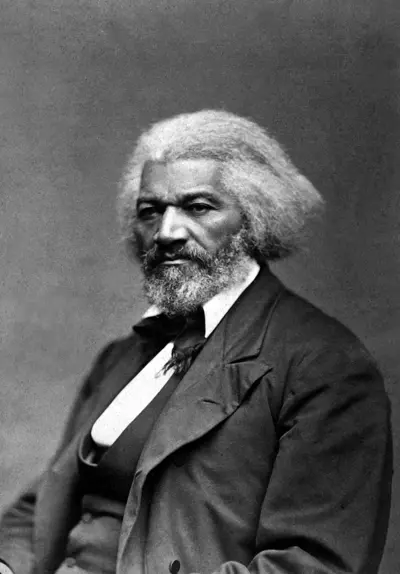
Frederick Douglass was an American social reformer, abolitionist, orator, writer, and statesman. After escaping from slavery in Maryland, he became a national leader of the abolitionist movement in Massachusetts and New York, becoming famous for his oratory and incisive antislavery writings. Accordingly, he was described by abolitionists in his time as a living counterexample to slaveholders' arguments that slaves lacked the intellectual capacity to function as independent American citizens. Likewise, Northerners at the time found it hard to believe that such a great orator had once been a slave.
