George W. Wickersham Quotes
The fact is, that the treaty-making machinery of the United States has become so complicated as to be almost unworkable. Only by the exercise of great powers of conciliation or of domination by the President, or by awakening and directing upon the Senate a vigorous public opinion, can any progress be made in international relations. A body of ninety-six men of such diverse characteristics and opinions as the members of the Senate is almost hopeless as an executive force. But it is ideal for purposes of obstruction.
This problem had not been resolved even by the beginning of the 21st century. With the inclusion of Hawaii as a state, there became 100 senators and the obstruction possibilities were even greater.
George W. Wickersham, 1858–1936, Attorney General of the United States (Republican), President of the Council on Foreign Relations, “The Senate and Our Foreign Relations”, Foreign Affairs, December 1923
Sourced by: Eigen's Political and Historical Quotations

The majority of the country strongly favored American participation in the League of Nation provided there were some reservations that made it explicitly clear, the American troops could not be committed without the approval of Congress and that nothing would impinge on U. S. domestic sovereignty. Wilson wanted no exceptions or reservations to the treaty he had negotiated and would not compromise in any way. The issues were soon forgotten in what had become a test of will and power between the Senate and the President. The treaty was never ratified and without the United States, the League of Nations collapsed.


From this quotation, {624648} and {615902} it is clear that the framers of the Constitution intended the treaty making powers to be shared by the President and the Senate. In practice, in modern times treaties are usually initially negotiated by diplomats under the supervision of the President and the Senate gets to concur or not in the ratification process. However, there have been a number of treaty failures including the League of Nations where the lack of coordination has resulted in a situation where the Senate had to accept or reject something which the President had negotiated and the Senate rejected the treaty.

From this quotation, {624648} and {615901} it is clear that the framers of the Constitution intended the treaty making powers to be shared by the President and the Senate. In practice, in modern times treaties are usually initially negotiated by diplomats under the supervision of the President and the Senate gets to concur or not in the ratification process. However, there have been a number of treaty failures including the League of Nations where the lack of coordination has resulted in a situation where the Senate had to accept or reject something which the President had negotiated and the Senate rejected the treaty.


Senators have throughout our history used their power of treaty ratification to encroach on the executive branch and participate in the actual negotiations of treaties. President’s like McKinley to avoid non ratification actually appointed 3 senators to his 5 man treaty negotiating team. The 2/3 super majority is a high hurdle for ratification and presidents have always tilted with the Senate on treaties.

Indeed, the control is only one the medium term when after 4 years a President can be replaced by the voters. But a number of President’s have embarked upon foreign policies that was opposed by the majority of the population.


Arguing that executive agreements were being used to circumvent the Senate right to ratify treaties:

The Senate debate on the ratification of the Versailles Peace Treaty was difficult for President Wilson, who wanted the treaty ratified without reservations or exceptions:. Wilson would accept no reservations and the treaty was never ratified.

President Wilson had gone to Paris for peace treaty negotiations. Ex-President Roosevelt was on his deathbed. But even then TR was his politically contentious self.

In the early 18th century, the succession to the Scottish and English Crowns was unclear. As a safety valve and check, this clause was adopted by the Scottish Parliament. This was one of the most radical and anti monarchy laws ever passed. It took the unilateral power of making war and peace from the king & established the principle of ratification of ALL treaties. The law did not last long. It was nullified by the Union between England & Scotland (1707), and the English Parliament specifically repealed the clause in the “Repeal of Certain Scotch Acts of 1707”. This clause, which only remained in force for 3 years, had a profound effect on the modern democracies. The American founding fathers were totally familiar with the recent English history & this law. So the American’s at the Constitutional Convention of 1787, built the principle into the new Constitution giving the Congress the power to Declare War and the Senate to ratify treaties as a check against Presidential power.

President George W. Bush initiated an invasion of Iraq based on the fact that Iraq was developing nuclear, chemical and biological weapons. After the invasion however, there were none of these weapons found and much evidence that there were not any at that point in time. By the time Congress, the body which is supposed to declare war, found out that the reason for the war was bogus, it was too late. We had already occupied the country and were in the midst of a civil war. The President either acted on bad intelligence or wanted to invade Iraq for other reasons and history may finally tell us which, but Fein sees the problem as too much secrecy in the executive branch.


The Republican controlled Senate had turned down the ratification of the League of Nations presented by Democratic President Wilson, and looked like they would turn down any international treaty even if presented by a Republican President. This statement allowed the treaty ratification by only a few votes. However, after that the Senate turned down our participation in the Permanent Court of Arbitration at the Hague. See {640099}.


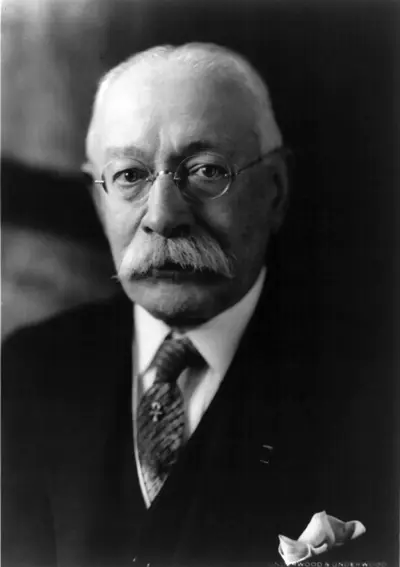
George Woodward Wickersham was an American lawyer and Attorney General of the United States in the administration of President William H. Taft. He returned to government to serve in appointed positions under both Republican and Democratic administrations, for Woodrow Wilson, Herbert Hoover and Franklin D. Roosevelt. He was President of the Council on Foreign Relations for the latter.
