Clifford P. Case Quotes
We are not put in the Senate to deal only with treaties on copyrights, extradition, stamp collections and minor questions of protocol.
Arguing that executive agreements were being used to circumvent the Senate right to ratify treaties:
Clifford P. Case, 1904-1982, U. S. Congressman & U. S. Senator (Republican, NJ), Senate Debate, June 19, 1972
Sourced by: Eigen's Political and Historical Quotations


Because the Senate has not ratified some international treaties, the United States does not participate in some international efforts to create international rules and law. The reason for non-ratification is generally given as potential loss of American sovereignty. At the same time, we spend billions of dollars trying to influence and shape the world along free market, democratic lines, and then are not able to participate in some of the most important forums where we could do just that. It is a constant dilemma and the Senate goes both ways depending on its mood, public opinion at the time and the political composition of the Senate. See {637031} and {637032}.

The Republican controlled Senate had turned down the ratification of the League of Nations presented by Democratic President Wilson, and looked like they would turn down any international treaty even if presented by a Republican President. This statement allowed the treaty ratification by only a few votes. However, after that the Senate turned down our participation in the Permanent Court of Arbitration at the Hague. See {640099}.


The notion of Executive Privilege developed over the years. Our first President thought nothing of giving the Senate access to all the papers and records regarding the negotiations of the treaty with Great Britain.


2nd Viscount Melbourne. The “American treaty” was the Webster–Ashburton Treaty to adjust the final borders between Canada and the United States that were still in dispute from the War of 1812. Note that the British Prime Minister was critical of the position that was being taken be some British diplomats. In many American negotiations with Russia and others, there are hard liners who believe that the negotiators want too much to preserve peace and are not sufficiently willing to go to war for the nation’s principles and honor. As this quotation shows, this is not just an American phenomenon, but in almost all nations there are hard liners critical of all international negotiations and fearing that a desire for an agreement will undermine the positions that should be taken. This is an example where the hard liners were on the non American side.


The minister had refused to be pressured by the George W. Bush Administration to sign an agreement with the US agreeing never to turn over an American or a foreign national working for America to the International Criminal Court (ICC). Even if a Peruvian or other non-American were working for an American Agency as an informant, agent, or other role, the country could not respect the treaty obligations that they had already made with regard to the ICC. Peru was “punished” losing $4 million aid. Nations were so “punished” while the State Department was spending huge sums to remedy negative opinion that so many nations had developed for the US during the George W. Bush administration. See {585493},65901 & {585496}, for more quotations on this. The US did not join the ICC Treaty as in some countries political considerations and different ethical values have labeled some American legitimate behavior as criminal and have attempted to hold individuals responsible for carrying out lawful orders. So many foreigners could understand the United States not wanting to deny Americans and others in the United States the protection of the United States Constitution, there was ire at the US pressuring others to boycott the ICC and break their existing treaties.

Galloway, a witness before the committee who had always criticized the American and British Policy of Iraq invasion to eliminate weapons of mass destruction, had also predicted the insurrection and resistance to the American and British occupation had been attacked by Coleman for taking campaign contributions from British Islamic terrorists—see {616260}. Coleman expected the typical American hearing behavior where Senators can berate witnesses who generally behave docilely in defending themselves. He was not used to the English style of political debate which is much more aggressive and Colemen was nonplussed when Galloway came up with this put down.


Explaining why he would not travel abroad during the presidential campaign:

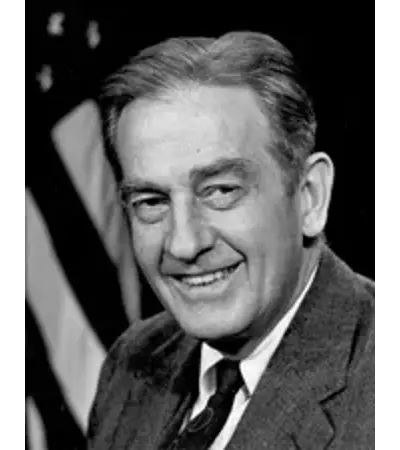
Clifford Philip Case, Jr., was an American lawyer and politician. A member of the Republican Party, he served as a U.S. Representative (1945–1953) and a U.S. Senator (1955–1979) from New Jersey.
