Robert M. La Follette Quotes
The consumer knows that his prices are made for him by those who control the avenues of trade and the highways of commerce.
Robert M. La Follette, 1855-1925, Governor of Wisconsin (Republican), U.S. Senator (Republican, WI), Presidential Candidate (Progressive), Senate Speech, April 23, 1906
Sourced by: Eigen's Political and Historical Quotations


Collection of Spoken Words of the Prophet. Ironically, despite the reverence with which words of the Hadith are accorded in Islam, from time to time Muslim theologians and authorities have attempted to establish “fair prices” despite this free market view of the Prophet.

Most companies in a capitalistic system compete mightily to obtain monopolistic positions so they can avoid capitalistic competition thereafter.


See {642189} where Sherman explained some of the reasons for the law.


Brandeis was U. S. Supreme Court Justice Louis D. Brandeis, 1856-1941, who wrote that competition would control prices if only healthy competition could be maintained—the problem was resolved by both increasing competition and much more stringent regulation of corporations.

Manava Dharma Shastra. Ancient Hindu India had what may well have been the most regulated mercantile economy of any society in history. All prices for all goods were to be set by the king. In order to prevent the stultifying effect of price controls, the Hindus required that the prices be reset very frequently to reflect various market conditions. It was a highly regulated form of capitalism. This text is a part of the Hindu Holy Texts. Hindus believe that Manu was a prophet whose text is revealed or inspired.

Railroads and other large markets shared dominated by a few large corporations.


These appear to be the first economic regulations of New England. Note that although there was a Governor of the Colony, such economic issues were considered to be fundamentally religious in nature. Therefore Cotton—the leading cleric of the colony—was called upon to in effect legislate on the subject. Ironically, this is not terribly different from the theocracy in Iran or some other Muslim countries of today where like some of the early American Colonies, there was no separation of church and state.
Draft language is sometimes attributed to Senator George F. Hoar.


While this statement seems totally absurd to us today, at the time most politicians and judges believed it. Only the left wingers and the populists opposed the doctrine as well as most business owners who knew the truth but of course most preferred the have their own monopoly. One of the reasons the large American corporations did not want Jewish and Chinese immigrants is that those cultures supported highly competitive businesses and might give consumers a better deal or worse, their culture would argue for less monopoly and more competition. For more than half a century AT&T was given a monopoly over almost all telephone service in the United States. Finally the Federal Courts saw through the company propaganda, and ordered AT&T broken up. The “Baby Bells” have persuaded most state legislatures and regulatory bodies of this same argument, and almost every community of the United States has a monopoly on local wired local telephone service. The same is true about water and electricity and a great deal of American transportation. Every major company strives for as much of a monopolistic position the government will allow; some are overt like the electrical companies. Others are more subtle and use copyright and patents to be sure that there is no price or service competition. Fortunately, the high tech industry is to technologically competitive that prices have been have been going down constantly not like telephone and Internet connectivity, entertainment, education, and professional services.

She was then the European Commissioner for Competition
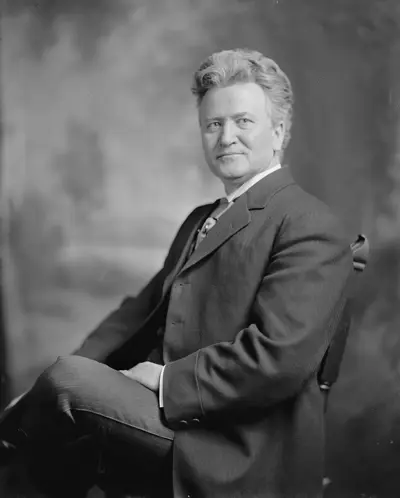
Robert Marion "Fighting Bob" La Follette Sr., was an American lawyer and politician. He represented Wisconsin in both chambers of Congress and served as the Governor of Wisconsin. A Republican for most of his career, he ran for President of the United States as the nominee of his own Progressive Party in the 1924 presidential election. Historian John D. Buenker describes La Follette as "the most celebrated figure in Wisconsin history."
