Antonin Scalia Quotes
In law school, I never understood [antitrust law]. I later found out, in reading the writings of those who now do understand it, that I should not have understood it because it did not make any sense then.
Antonin Scalia, U. S. Supreme Court Justice, Supreme Court Confirmation Hearings, August 5, 1986
Sourced by: Eigen's Political and Historical Quotations


Railroads and other large markets shared dominated by a few large corporations.


A justification of some mergers that would lessen competition was that the consumer would not be harmed as the merger will produce cost savings that could be passed on to the consumers. However, others argued that if the competition were reduced there would be no pressure on the merged companies to pass any savings along to the consumer. However, in this opinion, Justice Douglas set forth a basic principle of regulatory law: Even though the merger might have some consumer benefits, that is still no justification for doing.

Draft language is sometimes attributed to Senator George F. Hoar.


Here, an officer of a large corporation (Pittsburgh Plate Glass) makes the classic argument of large corporations about the anti-trust laws which prevent them from using their economic power to crush competition. The claim that the large corporations are at a disadvantage and handicapped in competing with small companies is easily refuted by the bankruptcy rate of small businesses which is large, and that of large corporations which is very small, and that of major monopolies which is virtually zero.

While this statement seems totally absurd to us today, at the time most politicians and judges believed it. Only the left wingers and the populists opposed the doctrine as well as most business owners who knew the truth but of course most preferred the have their own monopoly. One of the reasons the large American corporations did not want Jewish and Chinese immigrants is that those cultures supported highly competitive businesses and might give consumers a better deal or worse, their culture would argue for less monopoly and more competition. For more than half a century AT&T was given a monopoly over almost all telephone service in the United States. Finally the Federal Courts saw through the company propaganda, and ordered AT&T broken up. The “Baby Bells” have persuaded most state legislatures and regulatory bodies of this same argument, and almost every community of the United States has a monopoly on local wired local telephone service. The same is true about water and electricity and a great deal of American transportation. Every major company strives for as much of a monopolistic position the government will allow; some are overt like the electrical companies. Others are more subtle and use copyright and patents to be sure that there is no price or service competition. Fortunately, the high tech industry is to technologically competitive that prices have been have been going down constantly not like telephone and Internet connectivity, entertainment, education, and professional services.
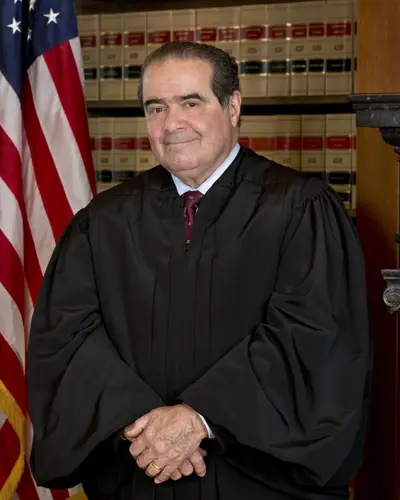
Antonin Gregory Scalia was an American jurist who served as an associate justice of the Supreme Court of the United States from 1986 until his death in 2016. He was described as the intellectual anchor for the originalist and textualist position in the Court's conservative wing. For catalyzing an originalist and textualist movement in American law, he has been described as one of the most influential jurists of the twentieth century, and one of the most important justices in the Supreme Court's history. Scalia was posthumously awarded the Presidential Medal of Freedom in 2018 by President Donald Trump, and the Antonin Scalia Law School at George Mason University was named in his honor.
