Nostradamus Quotes
The army of the sea shall stand before the city, then shall go away for a passage that shall not be very long, as a great prey of citizens shall be holding the ground. The fleet returns. The great emblem recovered.
Nostradamus. The Prophecies. Translated by Richard Sieburth, Penguin Classics, 2012.

This quotation shows that the French revolutionaries wished for an invasion of England, even before Napoleon came to power. Part of the reason was the traditional enmity between France and England, even before the French Revolution, and the other part that England was covertly working against the French Revolution and ideologically stood for monarchy and inequality, while the French of the time were Republicans for whom equality was not only an ideal, but part of the law and much of post-revolutionary reality.


Gallatin, then an Ambassador, was opposed to administration designs on Florida. In a response Monroe told him that Florida was going to be taken anyway, but in reality it had already been done so.


Jefferson was not the only one who thought that taking Canada and driving the English out would be relatively easy as Canada was vast and the English troops were spread very thin. However, although the English had great strategic weakness, the American officers who led the Canadian effort were not very competent and made a series of terrible tactical decisions and the Canadian operation failed in a terrible fiasco.

Ethiopia, then the only Christian country in Africa, was imperialistic and interested in private military adventurers to expand their empire just as the English, French, Belgians and Germans were. See Menelik’s statement on imperialism {607290}.

Ironically, when he attacked Athens in 480 BC, the Athenians under Themistocles, abandoned the city—see {612656}—and lured the overly-confident Xerxes into a sea battle at Salamis where the Persians were totally destroyed. A few public buildings of Athens were burned, but before Xerxes could fulfill his vow, he was defeated and had to retreat to Persia.

The phrase “put them under contribution” was a practice of making a town pay for the costs of the British military effort in the area. To some, this was blackmail and extortion, pay cash or get destroyed. The Prime Minister thought that the American public sentiment at the time would not be intimidated to pay in a significant number of towns or cities.

The French had agreed that once the Dutch started the uprising, they would send French troops to support the revolution. The French Revolutionary government was ideologically opposed to the Dutch Monarchy of the House of Orange on their border nor did they want the British influence which existed by virtue of the support England gave to William V and the Orangists. When the uprising started, the French kept their word and sent in an army of invasion to support the revolutionary government. See {639776}.

He conquered Korea in an act of blatant aggression, but got bogged down in a complicated occupation. He died before the Chinese part of the plan could be carried out. However, ever since China, Korea and other Asian countries have distrusted Japan and her aggressive intentions and history. The horrible Japanese record of aggression and atrocities of WWII solidified that anti-Japanese sentiment which still exists to some extent.

The Japanese Government was in the control of ardent militarists intent on expanding the Japanese empire. They invaded Manchuria and had designs on China. The League of Nations was very weak, in large part because the United States had not joined when the Senate refused to ratify the treaty. So peace or war In Asia depended on the fascist, military clique that ruled Japan.


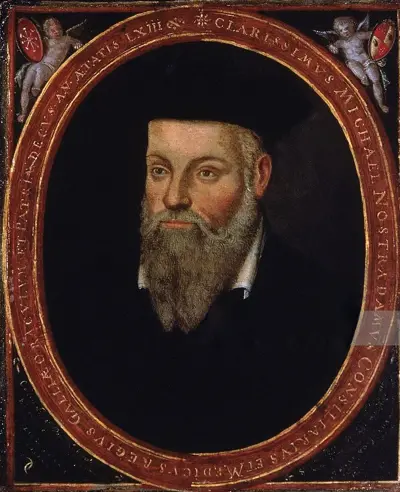
Michel de Nostredame (December 1503 – July 1566), usually Latinised as Nostradamus, was a French astrologer, apothecary, physician, and reputed seer, who is best known for his book Les Prophéties (published in 1555), a collection of 942 poetic quatrains[b] allegedly predicting future events.
