Menelik II Quotes
Plant the Ethiopian flag and make the inhabitants submit in all the country as far as the White Nile.
Ethiopia, then the only Christian country in Africa, was imperialistic and interested in private military adventurers to expand their empire just as the English, French, Belgians and Germans were. See Menelik’s statement on imperialism {607290}.
Menelik II, 1889-1909, Emperor of Ethiopia, Commission to French Lieutenants Bartholin and Charles Michel, October 12, 1897
Sourced by: Eigen's Political and Historical Quotations

We generally associate expansionism in Africa with the European powers, but under Menelik, Ethiopia expanded its empire greatly while the Europeans were carving up other parts of Africa. When the Italians who didn’t take Ethiopia seriously, tried to grab the territory that Menelik had already grabbed, Menelik’s forces repulsed then in a humiliating defeat for Italy at Adowa in 1896. As a Christian Empire, Menelik thought Ethiopia had a right to African expansionism along with the Christian European powers as bringing Christianity to the pagans was one of the major moral justifications of African expansionism.


The specific context of the quotation was the Navaho Indians enmity towards Kit Carson which extends to the present.

The contrast between the Christian piety memorializing the taking of the city and then as soon as the ceremonies were complete the pillaging and plundering, is dramatic. Religion controlled and permeated the military thoroughly at the time—even to the organization of un-Christian acts like plunder and murder of civilians.

‘Amalgamated’ was a euphemism for ‘being taken over by’. Ito was assassinated shortly thereafter by a Korean patriot who objected to Ito’s takeover of his country.


He had become a French Hero for leading a small expedition 2000 miles across Africa to take possession of Fashoda on the White Nile and then facing down the British who arrived later at this strategic place. An international incident developed and the French government yielded and finally ordered Marchand to withdraw.

Jefferson was not the only one who thought that taking Canada and driving the English out would be relatively easy as Canada was vast and the English troops were spread very thin. However, although the English had great strategic weakness, the American officers who led the Canadian effort were not very competent and made a series of terrible tactical decisions and the Canadian operation failed in a terrible fiasco.

In 1832 the President sent Edmund Roberts, a New Hampshire sea captain, to arrange commercial treaties with Asian countries such as Burma, Indo-China, Siam and Japan:


The Newspaper acknowledged that the conquest of Mexico was tantamount to a rape, but the editors were convinced that the Mexicans would be very happy once they were in the American orbit. In almost every case in American history where we invaded and occupied a country, the political leadership, most of Congress, and many American citizens were convinced that American freedom and democracy were so much better than any other form of government that the conquered people would not only welcome the Americans but would voluntarily reorganize their governmental structures to have a democracy. While there were always some people in each country who did feel that way, the majority rarely did, much to American surprise.

He was referring to land where there were people already living. People included Indians and Mexicans. He was one of the few American Presidents who were not enthusiasts for Manifest Destiny and expansionism of America.

Baratier wanted to defend Fashoda at all costs as a matter of French honor. The Minister was trying to broaden his understanding of French honor and avoid a military defeat. A diplomatic solution was found that preserved everyone’s honor.
There had been an era whereby the French military had conquered much of Africa without the approval of the civilian authorities.
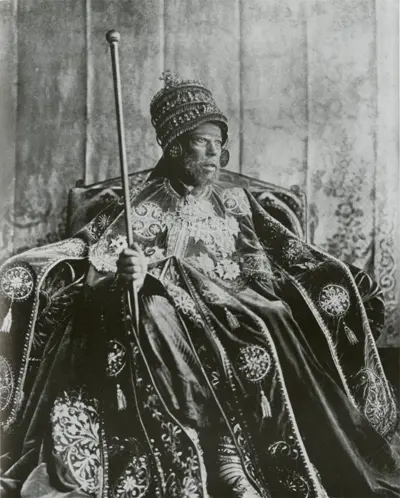
- Born: August 17, 1844
- Died: December 12, 1913
- Nationality:
- Profession:
Menelik II (Ge'ez: ዳግማዊ ምኒልክ dagmawi mənilək ); baptised as Sahle Maryam (Ge’ez: ሣህለ ማርያም sahlä maryam) was Emperor of Ethiopia from 1889 to his death in 1913 and King of Shewa from 1866 to 1889. At the height of his internal power and external prestige, the process of territorial expansion and creation of the modern empire-state was completed by 1898. He is widely honored by many Ethiopians and commemorated during the celebration of the Battle of Adwa, which is celebrated on March 1 or 2 across Ethiopia and in the diaspora. Many Pan-Africans regard him as an advocate for African independence against European powers during the Scramble for Africa.
