Eugene Etienne Quotes
If you drop a perpendicular from the frontier of Tunis, through Lake Chad to the Congo, you could say that the greatest part of the territories bounded by this line and the sea … are French, or destined to be included in France’s sphere of influence. We have a vast domain which it is for us to colonize and make fruitful …
Eugene Etienne, *, French Colonial Minister, Speech to the French Chamber of Deputies, May 10, 1890
Sourced by: Eigen's Political and Historical Quotations

Grey’s statement which had been made without any coordination with the Prime Minister, came to be called the “Grey Declaration,” and was the talk of diplomatic Europe. Grey claimed to be only talking about a hypothetical possibility, but the French actually had designs on the “other side” of Africa. They perceived that Grey was threatening war and referred to the declaration as the “fameuse manifestation.” The French sought and obtained a rapprochement and left the Niger valley to the British.


The Indian allies of the French scalped some American colonists which for some whites was akin to the modern reaction to terrorist atrocities. The British and Americans then justified the scalping of their Indian allies as simple retaliation. While Indians had scalped before the whites ever came, the whites accelerated the practice. There was an economic element to scalping. The French “paid” their Indian allies in arms, blankets, trinkets and alcohol by the scalp as it was a crude way of “performance measurement.” Not to be outdone, the English adopted the same custom with the French allied Indians as targets. In North Carolina, for example, the “volunteer” rangers were paid the enormous rate of 10 pounds a scalp.


Ethiopia, then the only Christian country in Africa, was imperialistic and interested in private military adventurers to expand their empire just as the English, French, Belgians and Germans were. See Menelik’s statement on imperialism {607290}.
The proclamation was witnessed by O C Gagnon and Louis Jolliet.


The human rights abuses in the Belgian Congo were horrible. Natives who refused to work for the low wages were murdered or had their hands chopped off. The indigenous population was markedly reduced. Word of the atrocities started leaking out to Europe. It is not known whether the King really wanted any reform or just sent the instructions to cover himself. The instructions were not followed; the atrocities continued, and Leopold never took any steps to discipline his agents and minions. The Belgian Congo had the worst atrocities in the world until WWII.


Clinton was a founder of the society. Many sophisticated Americans were in despair about the consequence of White contact with the Indian, and this was even before the worst of the treatment which came later, beginning under the presidency of Andrew Jackson and continuing well into the 20th century. Of particular interest is Clinton’s prescient observations regarding Africa and Africans interacting with whites with slavery the overriding white motive. Clinton was one of the many Americans who were abolitionists from the beginning of the nation.

He was a great believer in moving large numbers of Dutch settlers to the Dutch colonies in the East Indies.


He had concluded that Spain, who then ruled the Philippines, was incompetent, cruel and immoral in its rule, but that the Filipinos were not educated or sophisticated enough to rule themselves. However, he felt that he had to protect our commercial interests in the islands and the region, and was worried that commercial interests of other countries would take over and control the area. Another reason that this is a very important quotation is that it indicates the anti-Catholic bias in America at the time. Note that the President stated that one objective was to “Christianize” them. However, Spain had been in the islands for over 300 years and most Filipinos were already Roman Catholic. However, Roman Catholics were then a much smaller proportion of the American population and many Protestants didn’t think Catholicism was a legitimate Christian Religion. When the majority of Americans thought of Christianizing other people, they thought of Protestant missionaries much like England. At the time there was very little criticism of the President for the “error” of stating that Filipinos should be Christianized when they were so already Spanish Colonial Policy and Practice was generally terrible and particularly so in the Philippines, See {629450}.


Executed by the English for his part in the Easter Uprising.
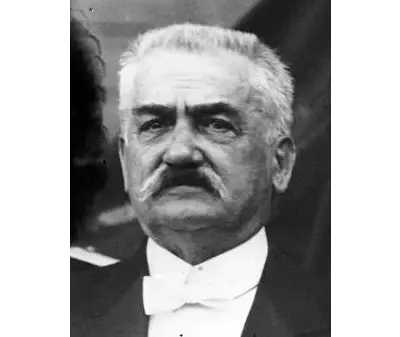
Eugène Etienne was a French politician who was a Deputy from 1881 to 1919, Minister of War in 1913, and a Senator from 1920 until his death.
