Joseph Stalin Quotes
This war is not as in the past; whoever occupies a territory also imposes on it his own social system. Everyone imposes his own system as far as his army can reach. It cannot be otherwise. If now there is not a communist government in Paris, this is only because Russia has no an army which can reach Paris in 1945.
Joseph Stalin, 1879-1953, Russian Premier, Statement, April, 1945, Quoted in Milovan Djilas, Conversations with Stalin, 1963
Sourced by: Eigen's Political and Historical Quotations

The British suspected that the Turks of Anatolia were complicit with Bolshevism

Most American felt that way at the time of the Russian occupation and the Mujahedeen resistance.

Ironically, at the time she wrote this column, Mrs. Roosevelt was being accused of being a communist by some Southerners who associated her strong views against racism and segregation. Some in the North thought she was a communist because of her active role in the New Deal, Yet here she was, willing to use military force to prevent Soviet expansion.


The issue of unilateral or multilateral foreign policy efforts faced America after WWII.


Leval was an appeaser and a collaborator with the Nazi’s. He led the government in name but the Germans really controlled the country. His actions killed tens of thousands of French men and women by turning them over to the Germans. After the Germans were defeated in WWII, Leval was shot as a traitor by the Free French forces.

The occasion was the visit to Washington of French Minister M. Jean Letourneau. The French were fighting the communists in Vietnam and the U. S., not yet in the fight, promised material and political aid, but no military participation. It was almost a decade later that America sent its first military personnel to Vietnam. The West was persuaded that the French could handle the situation. When they were defeated, America and Britain assumed that it was the notorious military incompetence of the French that accounted for the situation rather than the competence and commitment of the Vietnamese Communists and their support of the majority of the people.


Truman had to deal with Stalin for many years and over time he became more and more soured on the Russians. See {626411} for his view 22 years later,

This was an amazing prediction for the time. Most Europeans were not sure that the United States would even survive, and Russia was looked upon as the most backward nation in Europe. By the middle of the 20th century—over 100 years after Tocqueville wrote this—The United States and Russia were the two superpowers of the world.


The Scientific Project that developed the Atomic Bomb. He was a strong advocate for disarmament and that was being debated at the United Nations. He was critical of Bernard Baruch’s tactics but it soon was clear to almost all that the Russians were not interested in a serious UN supervised disarmament. Oppenheimer was profoundly disappointed when it was clear that disarmament was being blocked by the Russians and their veto. After that he didn’t trust the Russians, and concentrated on trying have US policies that would not goad the Russians into an arms race. This quotation is particularly important because in an effort to discredit his views on nuclear policy some politicians accused him of being a security risk with the innuendo that he was a communist and even a Russian agent.

A few months later, that is exactly what Germany did. She was hoping that England would not enter the war despite her treaty obligations, but she was willing to risk the possibility. The Czar had a strong espionage and intelligence service active in Germany, but, like so many other intelligence failures, the intelligence operatives and analysts had military and economic facts but had little understanding of the German culture which propelled Germany to what to most other cultures was “irrational policy making.” People and nations often engage in irrational activities, even against their own self-interest.

During the Cold War and afterwards many Americans attributed the problems we were having with the Soviet Union emenated from the fact that they were Communists, and our focus was anti-communism. Kennen, however argued that it was not Communism that was the cause of the Aggression of the Soviet Union. It was an extension of the Russian Culture. After the Soviet Union collapsed, and Communism was rejected by the Russians, we still had a great deal of Russian aggression and Foreign Policy problems with Russia. Kennan was right. It was the Russian culture, history, values and traditions that were the primary cause of most of the problems with Russia.


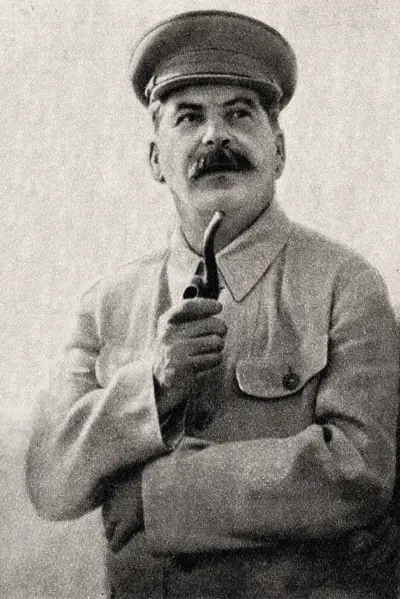
Joseph Vissarionovich Stalin was a Georgian revolutionary and the ruler of the Soviet Union from 1927 until 1953. He served as both General Secretary of the Communist Party of the Soviet Union (1922–1952) and Chairman of the Council of Ministers of the Soviet Union (1941–1953). Despite initially governing the country as part of a collective leadership, he ultimately consolidated power to become the Soviet Union's de facto dictator by the 1930s. A communist ideologically committed to the Leninist interpretation of Marxism, Stalin formalized these ideas as Marxism–Leninism while his own policies are known as Stalinism.
