Edward Teller Quotes
I tried to contribute to the defeat of the Soviets. If I contributed 1%, it is 1% of something enormous.
Teller, Edward, and Judith L. Shoolery. Memoirs: A Twentieth-Century Journey in Science and Politics. Perseus Publishing, 2001, p. 541.


Ironically, at the time she wrote this column, Mrs. Roosevelt was being accused of being a communist by some Southerners who associated her strong views against racism and segregation. Some in the North thought she was a communist because of her active role in the New Deal, Yet here she was, willing to use military force to prevent Soviet expansion.


Wright, like so many idealists had been a communist before the reality about Stalin and Russia was public knowledge. He then became a virulent anti-Communist and appeared in many international gatherings of Black artists and intellectuals. However, he felt that the CIA funding of an organization called the American Society for African Culture was undermining his message and integrity.’


Alabama and Mississippi were not the only states which not only tolerated but mandated segregation. All the Southern States did. But these two were the worst offenders.


The British suspected that the Turks of Anatolia were complicit with Bolshevism

The occasion was the visit to Washington of French Minister M. Jean Letourneau. The French were fighting the communists in Vietnam and the U. S., not yet in the fight, promised material and political aid, but no military participation. It was almost a decade later that America sent its first military personnel to Vietnam. The West was persuaded that the French could handle the situation. When they were defeated, America and Britain assumed that it was the notorious military incompetence of the French that accounted for the situation rather than the competence and commitment of the Vietnamese Communists and their support of the majority of the people.
In retrospect, the Marshall plan was so successful that most people forget or never knew that there was much domestic and foreign opposition and criticism. See {615799}.


In 1992 Russia was in terrible economic shape after the fall of the Soviet Union. Keeping up with the United States military expenditures had bankrupted the Russians. The United States which had strategically increased its defense spending to break the Russian economy if they tried to keep up. However, the U. S. expenditures had forced America into a deficit spending period which produced a national deficit greater than all the previous cumulative deficits in our history. So the American economy was not in great shape either. Meanwhile, Japan, whose constitution (imposed by America after WWII) forbade having a military and funding a military. The result was the Japanese economy was growing at a much more rapid rate, and did not have the unbalanced budget of the United States and Russia. Hence, Tsongas’ observation.

This was a very prescient prediction. Russia and China as well as lesser communist states have followed his prediction.


McNamara stated that the Cuban Missile Crisis was more politically required than defense required. The Russians had nuclear missiles at the time that could reach the United States and didn’t really need missiles in Cuba to threaten America. Public opinion and the Republican Political doctrine persuaded President Kennedy that independent of safety and military factors, nuclear missiles in Cuba was a major political problem. See his comment to the President and the Other Officials dealing with the crises—{631968}.

At the time, the Red Scare was prevalent and many Americans were terrified of communists. It was a very effective political tactic to imply that an opponent was a communist or communist sympathizer. For another harsh smear of Stevenson, see {619523}.

This editorial marked what most people agreed was the end of the Cold War.
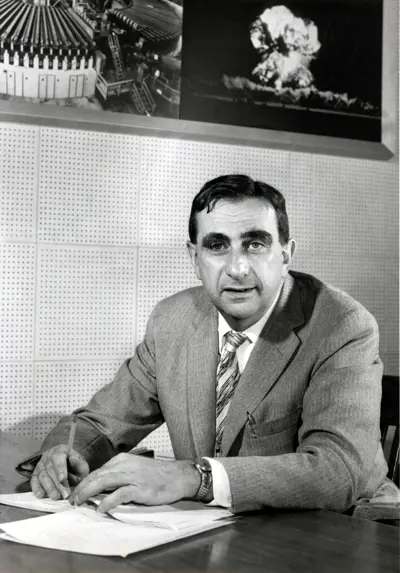
Edward Teller was a Hungarian-American theoretical physicist who is known colloquially as "the father of the hydrogen bomb" (see the Teller–Ulam design), although he did not care for the title, considering it poor taste. Throughout his life, Teller was known both for his scientific ability and for his difficult interpersonal relations and volatile personality.
