John Mitchel Quotes
The Almighty indeed sent the potato blight, but the English created the famine.
This fiery statement got Mitchel sent to a penal colony in Australia from which he escaped and came to the United State. It was essentially true. Despite the potato famine in much of Ireland, there was a constant supply of different foods exported from Ireland to England. There were many ways that they Irish could have had food, but they all required some money and there was a massive depression with many Irish out of work and also unable to grow potatoes. The “political philosophy” of the English rulers of Ireland however precluded any kind of welfare, relief or food assistance—see {636214}.
John Mitchel, 1815-1874, Irish Journalist & Founder of United Irishman, Founder of The Irish Confederation Quoted in New York Times, March 20, 2014
Sourced by: Eigen's Political and Historical Quotations

During the Potato Famine in Ireland his philosophy led him to do little or nothing while over a million Irish starved. The philosophy was later echoed by American President Herbert Hoover during the Great Depression except that the situation was not so bad, and a much smaller percentage of the population was starving. The moral hazard question is still argued whenever welfare, unemployment insurance and social safety nets are politically debated, moral hazard is still an issue. Trevelyan was at an extreme, inhumane posture on this point, with Hoover about in the center for his time, but the Potato Famine and the Great Depression changed Ireland, England, the United States and most of the rest of the world, and now the debate is to the extent of the welfare and methods of ameliorating the moral hazard.

Executed by the English for his part in the Easter Uprising.


During the Irish Potato the official who was in charge of the relief program was a highly religious, fundamentalist Christian who believed that the famine was God’s retribution.


1st Earl of Beaconsfield

During the Irish potato famine, other crops continued to be exported from Ireland. Some argued that without the exports the Irish economy would totally collapse exacerbating the pain to Ireland, but many others disagreed and argued that all available food should be used for the people of the country. For his seditious activities he was sentenced to penal servitude for life. He escaped and came to America where he entered politics


“Sir Robert” was Prime Minister Robert Peel. See {630737}.

Many have argued that if the Irish famine had affected the wealth of the country, the problem would have been solved. The vast majority of the dead Irish were unskilled peasants who were not needed for their labor. Therefore, no one had a vested economic interest in ending the starvation, and the people who had the moral motivation to do so did not have the means or the skill to do so.


He was particularly referring to the reigns of Queen Elizabeth I and James I.
Reflection on the Irish Potato Famine of 1845-1850
Reflection on the Irish Potato Famine of 1845-1850
Many Irish use the term “race” in a cultural sense. To them, the Irish are a different race from the English or the Italians.

Beaumarchais served the French King Louis XVI as a spy and advisor on foreign affairs. He was instrumental in influencing the French King and his government to tilt in favor of the American Revolutionaries.

Britain, in order to protect the landed gentry and aristocracy who made their money via agriculture, long had the Corn Laws (Corn was the term for wheat.) which was a protectionist system making it virtually to import food grains, rice or potatoes into Britain. However, with the growth of the population and a protected agricultural industry that had no drive to be more productive there was not quite enough food in the kingdom. When there was a potato blight in Ireland, the situation reached critical proportions. Victoria was not generally in favor of protectionism, and given the shortage and high cost of food then, she wanted to allow food imports. Robert Peel presided over a government where the protectionists who represented the large landowners had a very strong block. Pushing for an end to the Corn Laws could have caused the government to collapse. Peel himself did not think the Corn Laws were good policy and created a hardship for most people especially the poor. But he was the leader of his party and the party was split on the Corn Law issue. Victoria, in this private letter, tells him to do what he things is right and not what is politically expedient. Peel tried but at this time could not get a majority to repeal the Corn Laws, and the Irish Potato Famine killed millions. See {630738} . Peel however stuck with the Queen’s and his perception of what was right. The following year he proposed the Importation Act 1846 which repealed the Corn Laws. Many of his own party would not support it, but this time, he went to the two opposition parties and created a slim majority which passed the bill much to the approval of the Queen.
1st Earl of Beaconsfield. O’Connell was an Irishman.
1st Earl of Beaconsfield
The Murrain was phytophthora infestans a highly contagious fungus that attacked the strain of potatoes planted in Ireland at the time. The worst thing about the blight was that the Irish poor had developed such a narrow diet that the potato was virtually their only food. See {639195} and {639196}.

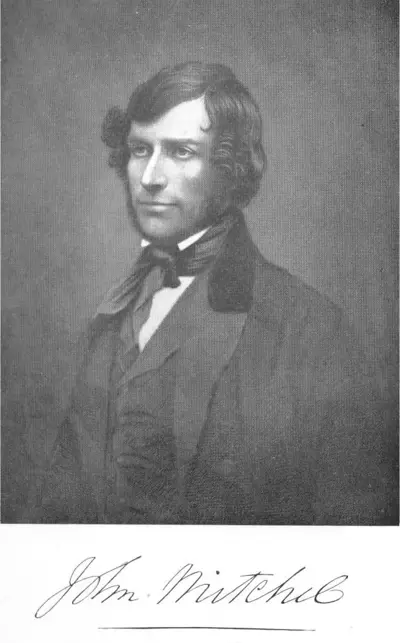
- Born: November 3, 1815
- Died: March 20, 1875
- Nationality: Irish
- Profession: Journalist, Author, Soldier
John Mitchel was an Irish nationalist activist, author, and political journalist. In the Famine years of the 1840s he was a leading writer for the Nation produced by the Young Ireland group and their splinter from Daniel O'Connell's Repeal Association, the Irish Confederation. As editor of his own paper, the United Irishman, in 1848 Mitchel was sentenced to 14-years penal transportation, penalty for his advocacy of James Fintan Lalor's programme of co-ordinated resistance to exactions of landlords and to the continued shipment of harvests to England. Controversially for a republican tradition that has viewed Mitchel, in the words of Pádraic Pearse, as a "fierce" and "sublime" apostle of Irish nationalism, in the American exile into which he escaped in 1853, Mitchel was an uncompromising pro-slavery partisan of the Southern secessionist cause. In the year he died, 1875, Mitchel was twice elected to the British Parliament from Tipperary on a platform of Irish Home Rule, tenant rights and free education, and twice denied his seat as a convicted felon.
