Mahatma Gandhi Quotes
So far as I can see, the atomic bomb has deadened the finest feeling that has sustained for ages. There used to be so-called laws of war, which made it tolerable. Now we know the truth. War knows no law except that of might. The atomic bomb brought an empty victory but it resulted for the time being in destroying the soul of Japan. What has happened to the soul of the destroying nation is yet too early to see.
Gandhi, Mahatma. "Atom Bomb and Ahimsa." Harijan, 7 July 1946.

Fermi was the scientist who organized and planned the first controlled nuclear chain reaction as a part of the Manhattan Project and was one of the major scientific advisors to the Atomic Energy Commission until he, Oppenheimer, and several other scientists opposed the development of the Super (the name Edward Teller had given to the proposed hydrogen bomb). The scientists knew that we had and could make enough atomic bombs to destroy any nation and to make it doable with just a few bombs as opposed to many they saw as of little military
value. They further expected that the Russians and some others would be forced to keep up with us in an arms race and that the bomb would never be able to be used without retaliation in kind and the destruction of most of America. The politicians and military did not really believe that the Russians had the scientific capability to develop hydrogen weapons and some thought if we had them and no one else did, we could dictate a “pax Americana” to the world. Others feared that Russia or some other country would develop a hydrogen weapon and then dictate to us. We did have a monopoly on the Super for a few years and America never dictated to the rest of the world. When other countries developed the weapons, we entered the era of Mutually Assured Destruction (MAD).


Truman had been briefed on the number of Japanese who committed suicide rather than surrender—including civilians—in Saipan, Okinawa, Iwo Jima, and other locations where United States troops had invaded. He and his experts agreed that the Japanese would not surrender unless there was a new dramatic factor that was outside the usual thinking—the atomic bomb. He was proved right about the warning. Not only did the Japanese ignore it, but they did not even surrender after the nuclear devastation at Hiroshima. It took a second bomb dropped on Nagasaki to motivate the surrender. So even a demonstration with all those Japanese casualties did not cause the surrender until it was repeated.

Bombing had reached the point where conventional bombing raids on industrial cities like Tokyo and Hamburg produced even more civilian casualties than did the atomic bomb at Hiroshima. Tibbets’ view, through the lens of hindsight, was developed by many of the Allied servicemen who had been forced into war by expansionist and militaristic nations like Japan and Germany both of which placed much of their war material manufacturing capability in the midst of their otherwise civilian cities. Both brutally violated the laws of war and committed atrocities many times over before the allies began retaliating. There are still some who believe that it was wrong to drop the atomic bomb on Japan. Some even feel that the mass bombing of Japanese and German cities in retaliation and in furtherance of the war effort was morally wrong. But at the time, the millions of casualties anticipated in the invasion of the Japanese mainland, persuaded virtually every American soldier and civilian that there was nothing wrong with use of the Atomic bomb, and many saw it as an absolute Godsend to prevent all the American and Japanese causalities that would have come otherwise. Many scholars remark on how it was virtually impossible to find any significant number of misgivings before or just after Hiroshima. Tibbet’s view was typical.


The second atomic bomb had just been dropped.


This is one of the earliest uses of the phrase “weapons of mass destruction.” Panneloek quoted it in 1948, so it was used by Urey before then.

Alvarez was a scientist who worked on the Manhattan Project developing the atomic bomb:

The Gallup poll at the time showed that 85% of the American public favored use of the atomic bomb.

Although generally a right wing conservative, Clark today sounds like almost like an extreme leftist on the issue. At the time however, many thought that he had taken leave of his senses. He not only was completely contrary to bipartisan national policy but opposed by almost universal American public opinion. He is one of the very few significant American officials to oppose the war policies.

The concept of Mutually Assured Destruction (MAD) has inhibited the use of atomic weapons since WWII. If one nuclear nation attacked another, the attacked nation would still have time to retaliate and both countries would be destroyed. However, Iran by their own statements and past history might not be inhibited by large losses and death in retaliation. Iran, a theocracy, has a religion that believes that any Muslim who is killed in defense of Islam will immediately go to heaven. They have sacrificed hundreds of thousands of their citizens in their war with Iraq. Iran is a much larger country than Israel where a single nuclear bomb would destroy the whole nation. One retaliatory bomb would do terrible damage to Iran but much more of the country and its people would survive. The Iran fanatics might make such a tradeoff as a religious obligation. This is why, most of the world is doing much to prevent Iran from getting a nuclear weapon at all. Rafsanjani’s logic however assumes that if Iran fired one bomb, Israel would retaliate with one bomb. However, Israel has the capability of carpeting all of Iran with a nuclear muti-warhead retaliation so Iran would also be completely destroyed. However Israeli policy has been to never discuss anything about nuclear weapons and their policies. Some ultra-fanatical Muslims have argued that even of all of Iran and its people were destroyed, this would be a worthwhile “martyrdom” so that the remainder of the Muslim world would be free of Israel. This is illustrative of how difficult it is negotiating with religious fundamentalists who control a nation.

The Scientific Project that developed the Atomic Bomb. Oppenheimer was the great physicist who directed the successful development of the atomic bomb so as to build the weapon before Hitler did in World War II. However, as the technology evolved, he had doubts as to the wisdom of creating even more powerful hydrogen weapons. His viewpoint was hurting the administration’s policy of rapid unlimited nuclear weapons development, and he was the victim of a character assassination whereby his security clearance was withdrawn. The “father” of the atomic bomb was the first American casualty of atomic weapons development.


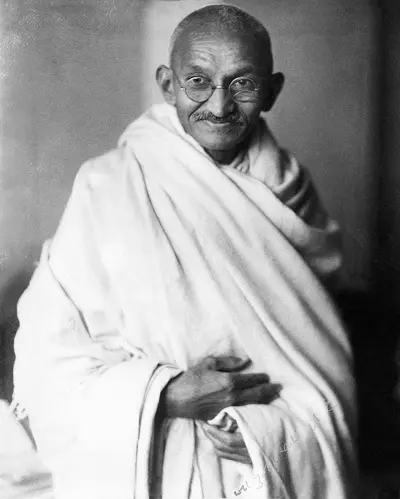
Mohandas Karamchand Gandhi was an Indian lawyer, anti-colonial nationalist, and political ethicist, who employed nonviolent resistance to lead the successful campaign for India's independence from British rule, and in turn inspired movements for civil rights and freedom across the world. The honorific Mahātmā (Sanskrit: "great-souled", "venerable"), first applied to him in 1914 in South Africa, is now used throughout the world.
