John Lewis Gaddis Quotes
I think the way to think about the impact of Hiroshima is to think about it as a sudden shift in the balance of power.
Gaddis, John Lewis. Interview. American Experience: Race for the Superbomb, PBS, 1999.


He was right. Before WWII Russia was not considered a very important country in the world, but having emerged from WWII, Russia was stronger than ever and counties like Germany and Italy were in ruins.

Truman had been briefed on the number of Japanese who committed suicide rather than surrender—including civilians—in Saipan, Okinawa, Iwo Jima, and other locations where United States troops had invaded. He and his experts agreed that the Japanese would not surrender unless there was a new dramatic factor that was outside the usual thinking—the atomic bomb. He was proved right about the warning. Not only did the Japanese ignore it, but they did not even surrender after the nuclear devastation at Hiroshima. It took a second bomb dropped on Nagasaki to motivate the surrender. So even a demonstration with all those Japanese casualties did not cause the surrender until it was repeated.


Bethe and other European refugees joined American and British scientists at Los Alamos, NM, for the development of the atomic bomb.

The only soldier ever so honored


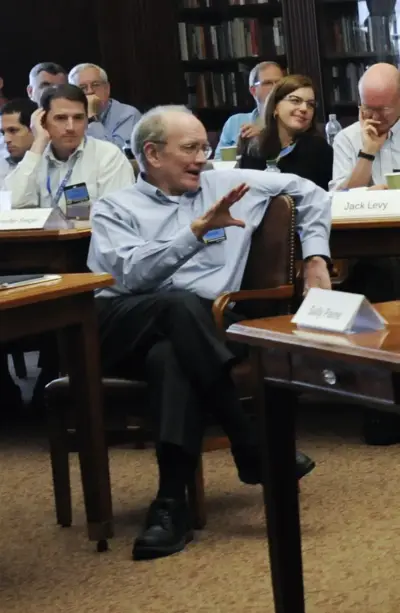
John Lewis Gaddis (born 1941) is the Robert A. Lovett Professor of Military and Naval History at Yale University. He is best known for his work on the Cold War and grand strategy, and he has been hailed as the "Dean of Cold War Historians" by The New York Times. Gaddis is also the official biographer of the seminal 20th-century American statesman George F. Kennan. George F. Kennan: An American Life (2011), his biography of Kennan, won the 2012 Pulitzer Prize for Biography or Autobiography.
