Archibald MacLeish Quotes
What happened at Hiroshima was not only that a scientific breakthrough had occurred and that a great part of the population of a city had been burned to death, but that the problem of the relation of the triumphs of modern science to the human purposes of man had been explicitly defined.
MacLeish, Archibald. Freedom Is the Right to Choose: An Inquiry into the Battle for the American Future. Beacon Press, 1951, p. 11.


The Scientific Project that developed the Atomic Bomb. Oppenheimer was the great physicist who directed the successful development of the atomic bomb so as to build the weapon before Hitler did in World War II. However, as the technology evolved, he had doubts as to the wisdom of creating even more powerful hydrogen weapons. His viewpoint was hurting the administration’s policy of rapid unlimited nuclear weapons development, and he was the victim of a character assassination whereby his security clearance was withdrawn. The “father” of the atomic bomb was the first American casualty of atomic weapons development.


See {624449} for the essence of the letter.


For a similar view from the eyes of an American, see Pearson {612242}.


The Scientific Project that developed the Atomic Bomb

This is a very important quotation. It is often cited by preventive war hawks to show that deterrence might not be a sufficient inhibitor against an extreme ideological enemy. In this case it was political philosophy that would make the enemy willing to have the majority of its population die to reach the ideological objective. More fearful is the prospect of the Theocracy of Iran where the leaders may believe that nuclear jihad is a commandment of God. More critical is the Islamic theology which says that if most of the Iranian Muslim population die in a nuclear war that they start all those people will be martyrs and immediately go to God’s Paradise. Thus, even the dead Muslims are not victims and the nonbelievers should be killed. For extremely fanatical Muslims nuclear war can be a logical and holy course of action.

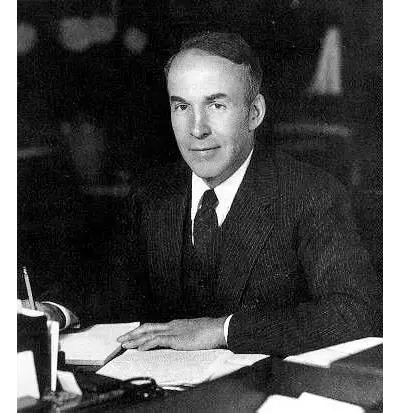
Archibald MacLeish was an American poet and writer, who was associated with the modernist school of poetry. MacLeish studied English at Yale University and law at Harvard University. He enlisted in and saw action during the First World War and lived in Paris in the 1920s. On returning to the United States, he contributed to Henry Luce's magazine Fortune from 1929 to 1938. For five years, MacLeish was the ninth Librarian of Congress, a post he accepted at the urging of President Franklin D. Roosevelt. From 1949 to 1962, he was Boylston Professor of Rhetoric and Oratory at Harvard. He was awarded three Pulitzer Prizes for his work.
