Swami Vivekananda Quotes
Religion has no business to formulate social laws and insist on the difference between beings, because its aim and end is to obliterate all such fictions and monstrosities.
Swami Vivekananda, 1863–1902, Narendra Nath Datta, Indian Hindu Monk & Teacher, Speech, World Parliament of Religions, 1893, Pearls of Wisdom
Sourced by: Eigen's Political and Historical Quotations

Robertson does not mention the fact that Hindus are the majority of the world’s largest democracy—India. Freedom thrives there and political equality is extensive. However, economic equality is sadly lacking as in the Untied States. However, India is more unequal.


Jinnah himself preached non-violence. At the time there was vicious sectarian violence throughout India but especially in The Frontier Province. However, the Muslims of the day did not heed him or Nehru or Gandhi for that matter and the violence continued. Jinnah however was a particularly shrewd politician who successfully used the threat of Muslim violence to obtain a separate Islamic state with Indian independence. He pointed to the threatening resolution issued earlier {627153}. The man who publicly preached peace, privately threatened violence.


See {618216} for a seemingly contradictory quotation by White.


What was particularly unusual about this quote was that Cronkite had always been so circumspect about his own political views and opinions and rarely expressed personal criticism of any group or movement. When he was the national anchor for CBS News, he was so non partisan that he became the “most trusted man in America.” By 2007 however, most of the radical religious right had organized a serious movement which unlike other self interest groups which wanted to expand their rights or benefits, much of the radical religious right strove to curtail the rights of other Americans who differed from them as to religious interpretation, concepts and role of government, sound family structure and relationships, gender equality, sex, and personal freedom.


This remarkable advice to his followers was all the more remarkable in that the Methodists were gaining adherents by appealing to the rectitude of people and opposing the corruption of much religion that had become commonplace. With this kind of original leadership Methodists have been among the most tolerant of Christian groups.

At first this clause appears to be very enlightened and establishing freedom of conscience. This clause allowed Catholics to practice freely whereas in other colonies they could not. However, as one reads on, it becomes clear that the “tolerance” is limited to Christians only. Then if one examines the exception within the parentheses and refer to the rest of the act—see {611994}—, one finds that even Christians who have certain theological beliefs are to be put to death—those for example who deny the holiness of the Trinity such as Unitarians who were a major group in the New England Colonies. It was a significant step at the time however to protect Roman Catholics.


The Governor had banished John Bowne, the Quaker from the colony. In general, he was opposed to Quakers, Jews and other “non-Christians.”

Pen name: Jack Nipps
Pen name: Jack Nipps

Head of the Sikh Religion. His teaching was that deeds determined the man, not the professed belief and that the existing religions turned man against man.
Toleration is a relative term. The Muslim Moors made Christians (and Jews) pay a special tax. At times they were forced to wear special clothing so that they could be readily identified. And they could not build churches larger or taller than the smallest mosque in the community. At times, their occupations were restricted but at other times Christians and Jews were appointed to the highest positions like Vizier. The Inquisition, in contrast, forced all Muslims (and Jews) to leave the country without any of their property or money or be tortured and killed—usually by burning at the stake unless of course that they converted to Christianity.


Some of the Homopbobic Rabbis prevailed on the government to block adoptions by homosexual couples who are otherwise well qualified.
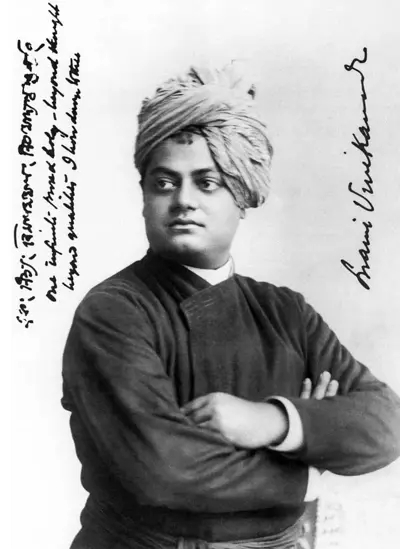
Swami Vivekananda, born Narendranath Datta (Bengali: [nɔrendronatʰ dɔto]), was an Indian Hindu monk. He was a chief disciple of the 19th-century Indian mystic Ramakrishna. He was a key figure in the introduction of the Indian philosophies of Vedanta and Yoga to the Western world, and is credited with raising interfaith awareness, bringing Hinduism to the status of a major world religion during the late 19th century. He was a major force in the contemporary Hindu reform movements in India, and contributed to the concept of nationalism in colonial India. Vivekananda founded the Ramakrishna Math and the Ramakrishna Mission. He is perhaps best known for his speech which began with the words "Sisters and brothers of America ...," in which he introduced Hinduism at the Parliament of the World's Religions in Chicago in 1893.
