James F. Byrnes Quotes
Provision was also made for the distribution of Germany's foreign assets among the Allies.
Byrnes, James F. "Restatement of Policy on Germany." Department of State Bulletin, vol. 15, no. 376, 15 Sept. 1946, pp. 496-501.


The railroads were nationalized for WWI and he ran them all as a government official. There have been political situations like this one where public opinion was so intense and extreme that any action that satisfied public opinion would have very negative aspects and/or be unrealistic or impossible while realistic solutions are unacceptable to public opinion. Usually, the reaction of the politicians is to punt and simply not deal with the issue or problem but claim that they are seeking a solution.

Nicolson was an eyewitness to the proceedings.

Germany had just attacked Russia with whom it had a treaty. For a while, Hitler paid little attention to Italy and just gave their “ally” orders and instructions. Italian public opinion was concerned about the same question. See {627973} .


The Germans pretended to maintain the treaty and when the French totally evacuated the Rhineland, Hitler started his preparation for WWII and a little later invaded France. Clemenceau had been snookered.
After WWI, the Germans were reluctant to make the reparation payments that they had agreed to in the WWI peace treaty. The French, to “motivate” the Germans, occupied the German Ruhr Valley—an area that contained very important German heavy industry and coal mines that could not function under the occupation. See {640090}.


The smaller German towns had not been targets for allied bombing and German censorship kept most Germans from realizing that the factories in the larger cities were being attacked. But the “rules of war” which the Germans had abandoned early in the war by bombing civilian targets in England and other European cities, required that only military targets be attacked. If a nation placed its factories or military bases in the midst of civilian populations, then the rules of war no longer protected the civilians. So the allies were within their rights by bombing the smaller towns where they targeted factories. However, this quotation is used by some critics to show that FDR’s motive was not the destruction of factories per se, but the breaking of German civilian morale. They argue that the allies were following the letter of the law, but not the spirit.


The Germans killed 22 million Russians, most deliberate murders and not collateral damage, in WWII.


Hopkins was a social worker with no military of political experience. But the President trusted him implicitly. Most American military officers and Ambassador to England Joseph P. Kennedy, a Nazi sympathizer & father of JFK, believed that England could not stand up to Hitler. Any military aid we gave England would fall into the hands of the Germans. Everyone was shocked when Roosevelt sent Hopkins to England to make a military recommendation. To impress Hopkins with something he thought Hopkins would be interested in, Churchill led a tour of workers cottages built by the government. Hopkins surprised Churchill and his aids who would never forget this statement & then asked to see the military facilities. Hopkins distressed the American military by recommending that Britain could hold out against invasion if they received military aid. Despite the contrary military advice, FDR accepted Hopkins’ recommendations, and the rest is history. He had been right and much of the military wrong.

The Nazis occupied the cities, but the partisans survived in the mountains. The resistance was ferocious and very effective. From a German Soldier’s point of view, the Yugoslav front was the most dangerous assignment where his odds of being killed was even greater than the Russian front.
The Professor was explaining the explanation of the so-called “Frankfurt School” of WWII policy advisors Franz Neumann, Herbert Marcuse, and Otto Kirchheimer.

This was the day after the Al Qaeda attack on the World Trade Center and the Pentagon, 9-11. Perle, a leading neoconservative advisor and guru, from that day on advocated for the invasion of Iraq. The irony was that at that time, Iraq had never attacked an American, anywhere in the world. Also, there was no Al Qaeda presence in Iraq. Many believe that the neocon main reason to invade Iraq was a regime change and democratization that would, they believed, be a catalyst for democracy throughout the Middle East. The supposed role in 9-11 and the WMD were for them just excuses to initiate military action, so they, the Vice President, and others who agreed with their objective did not question very seriously the so called intelligence about Iraq.
since the end of WWI The railroads were nationalized for WWI and he ran them all as a government official

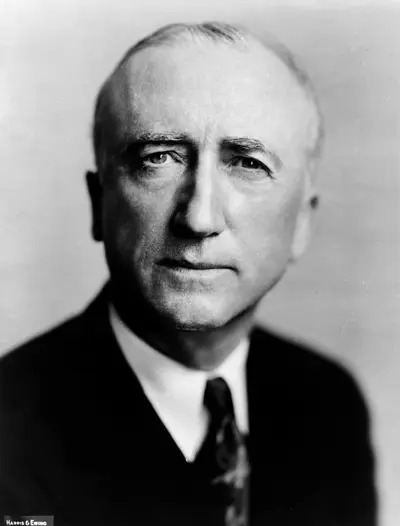
James Francis Byrnes was an American judge and politician from the state of South Carolina. A member of the Democratic Party, Byrnes served in Congress, the executive branch, and on the United States Supreme Court. He was also the 104th governor of South Carolina, making him one of the very few politicians to have served in the highest levels of all three branches of the American federal government while also being active in state government.
