Walter Raleigh Quotes
Our shipping and sea service is our best and safest defence as being the only fortification and rampart of England.
Raleigh, Walter. The Works of Sir Walter Ralegh, Kt. Vol. 8, Oxford University Press, 1829, p. 320.


This quotation illustrates several historical differences of the past with today. To be a world superpower, one had to have a dominant navy. Yet that navy was, in Churchill’s concept, a defensive system. It could protect the nation from invasion, and its merchant ships on the seas, but a navy provided no threat to invade towns and villages in Europe or elsewhere. Germany and France in contrast, with their large armies could invade other nations and menace Europe and Asia. It also illustrates why the navy and the army were considered completely separate departments of government in that they had different functions. The early American government had a Navy Department and Secretary but no Secretary of the Army or standing army.


Germany had a very small and insignificant navy. It was Tirpitz who persuaded the nation to develop sea power.


This is another example of the preparation that the American patriots were making before 1776 for the coming Revolutionary War. In this case they were urging the arming of ships. There were plenty of ships, and it was a matter of building or buying cannon and mounting them on the decks of the ships. While these were no match for a British Warship in a one-to-one duel, they could be effective against British Smaller Ships that could navigate the shoals, coasts and inlets where the large vessels dared not navigate. This foresight gave George Washington a small navy which he made very good use of. He had 8 schooners ranging from 40-80 tons, each armed with 4-10 cannon and manned by overly large crews (for sailing and firing the guns at the same time) of volunteer expert seamen from Marblehead and Beverly. Of the 35 supply ships the British sent to Boston in 1775, only 8 got through Washington’s Navy. Also note the form of the Continental Congress Resolutions. In effect they mandated nothing as there really was no federal government. Each colony was sovereign, so resolutions were suggestive only with the important decisions all left to the individual colonies and their various governments as some of the colonies had very strong local governments which made all the important decisions.


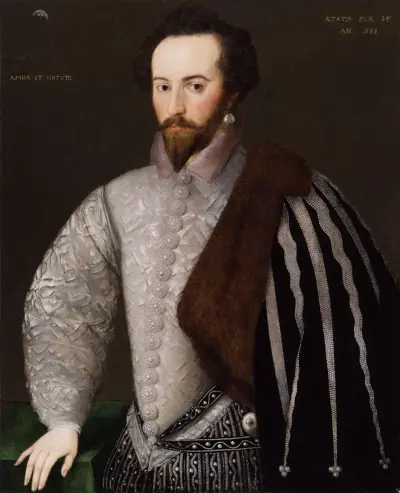
Sir Walter Raleigh, also spelled Ralegh, was an English statesman, soldier, spy, writer, poet, explorer, and landed gentleman. One of the most notable figures of the Elizabethan era, he played a leading part in English colonisation of North America, suppressed rebellion in Ireland, helped defend England during the Spanish Armada and held political positions under Elizabeth I.
