Fisher Ames Quotes
Our great committee is too unwieldy for this operation. A great, clumsy machine is applied to the slightest and most delicate operations--the hoof of an elephant to the strokes of mezzotinto.
He was referring to the entire House of Representatives. Ames and others thought the House too large and unwieldy to have ny meaningful discussion and debate meeting as a “committee of the whole.” He and others advocated dividing the House into committees which was done and has been such ever since.
Fisher Ames, 1758-1808, U.S. Congressman (Federalist, MA) and Harvard University President, Statement to George Richards Minot, July 8, 1789
Sourced by: Eigen's Political and Historical Quotations

After Adams’ term as President, he was elected to the House of Representatives where he served for the rest of his career. He was constantly calling for the emancipation of slaves (see {77463}) in the House debates. The Southern Congressmen were so offended by this that they got the majority of the House to pass a rule that made using the word “slavery” out of order. It was called the “Gag Rule”. Adams, one of the best legislators and lawyers of his day, then started reading in the House debates petitions of his constituents calling for an end to slavery. The Southerners called for the Speaker to declare him out of order for violating the gag rule. But Adams pointed out that the Constitution gave citizens the right to petition Congress with no controls on the petitions. Therefore the reading of the petitions was Constitutionally mandated and trumped the Rules of the House. He then arranged to have many petitions submitted which he dutifully read on the House floor to the extreme anger of the Southerners.

In 1871 the congressman refused to serve as chairman of a committee to investigate the Ku Klux Klan. Such pandering to the South was common for politicians who had national aspirtation. If the politican served on such a committee, he would have to aknowledge the existance of the murders, torture, and other criminal activity of an organzation that was very popular in the South. Or he would have to cover up the KKK crimes and lose the support of Northerners. So refusing to serve on the committee was the prudent solution.


In one of the most blatant statements of the arbitrary power of congressional committee chairmen, the chairman of the House Rules Committee blocked an investigation of military procurement even though every other member of the committee wanted to pursue the investigation. The prerogative of the chairman was upheld by the Speaker, and on appeal, by the House as a whole, but by 1924 House rules were amended to diminish the arbitrary power of chairmen.


It didn't take long in early America for legislative caucuses to spring up:

The senator had broken with his own party on the issue of slavery in the territories.


The House, under the control of the majority leadership, does not have to be very efficient or reasonable with respect to its own procedures. Leaderships of both parties care little of their caucus members read the legislation or not so long as they vote the party line as instructed by the leadership.

The Constitution sets the majority of each house as a quorum in order to conduct any business. Minorities, in order to obstruct proceedings, would often refuse to answer their names when a quorum call would made even though they were present in the House, Therefore they claimed they could not be counted towards a quorum. In those days there were always absences due to illness, transportation, family emergencies and the like. So the majority had to have most of its members on the floor at all times if the minority wanted too obstruct. The minority claimed it was their right under the Constitution, Reed said that interpreting the Constitution that way was tantamount to suicide for the House. He then changed the rule, and simply counted as present any member who was observed to be present, whether he answered a quorum call or not.

She had just given birth and found out that there were archaic rules adopted by the Senate.


The bills and legislative processes in Congress had become so large and convoluted that literally members of Congress either voted on bills that were so lage that they rarely read the entire bill or on procedures so arcane that the members could not determine ehate they were voting for. As a result most just followed the lead of their party's Congrssional Leadership.

This is an important political quotation because it illustrates one of the major reasons that Congress was so gridlocked at the time and passed hardly any legislation at all. Farenthold was a relatively new Congressman supported by the Tea Party extreme conservatives. He had no Congressional legislative experience and viewed the House / Senate Conference Committee process more like a Middle East rug bazaar than a serious democratic process of constructive legislation. The position that he wants to take to the Conference Committee which is “livable” to him is not only unlivable to the majority of the Senate, but unlivable for a large part of his own House of Representatives, His position is so extreme that most Senators and many House members on the Conference Committee do not even bother to attempt to negotiate from there. Experienced Congressional legislators realize that negotiation can only take place between realistic options. Otherwise no legislation gets passed which was at that time, OK with most of the Tea Party supporters.


The "administrative state" was the term used for a government had had powers and used them to regulate things and areas of society without each specific regulation being voted upon by the legislature. In America sicne the New Deal there have been so many areas that have regulations that a single agency like the Environmental Protection Agency might issue in a year more regulations than the entire Congress considers in all areas put together. All these regulatory powers are delegated by Congress passing legislation authorizing it, and Congress can legislate any change in any regulation it wants, but the modern state is so complesx and areas so specialzied that Congress has preferred to delegate. There are a few who legal scholars and politicians who believe that it is unconstitutional for the legislature to delegate powers to the executive branch and no regulations have validity unless specifically passed by Comgress. There are some others who have not taken a position on this point but who believe that of an administrative state can regulate phases of citizens lives it is bound to circumscribe personal freedom as all legislation does to some extent. This quotation was used by opponents of Judge Gorsuch in arguing that he was unfit for the Supreme Court as he was out of touch with the Administrative State which America gradually became and rapidly in the New Deal and in the 80 years thereafter a very extensive administrative state. Gorsuch's views were based on classic political pholosophy but there were some ultra conservatives who did not want any regulation of business by Congress or Administrative Agencies and therefore supported Gorsuch and the few others with this view as if Agencies were not able to issue regulations there was no practical way that Congress could issue as many and regulation would be reduced which is what they desired.
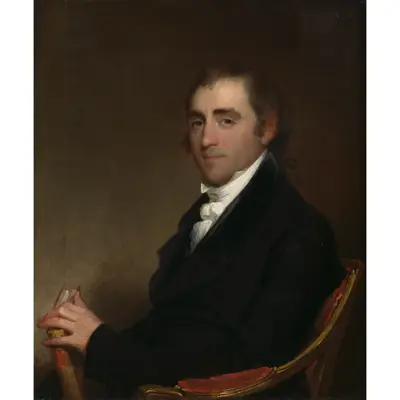
Fisher Ames was a Representative in the United States Congress from the 1st Congressional District of Massachusetts. He was an important leader of the Federalist Party in the House, and was noted for his oratorical skill.
