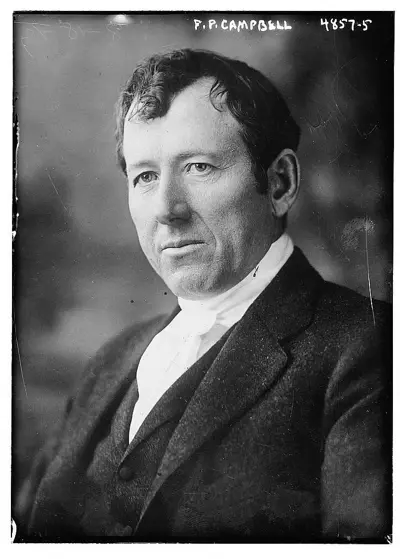
Philip P. Campbell Quotes
You can go to Hell! It makes no difference what a majority of you decide; I am the Committee ...
In one of the most blatant statements of the arbitrary power of congressional committee chairmen, the chairman of the House Rules Committee blocked an investigation of military procurement even though every other member of the committee wanted to pursue the investigation. The prerogative of the chairman was upheld by the Speaker, and on appeal, by the House as a whole, but by 1924 House rules were amended to diminish the arbitrary power of chairmen.
Philip P. Campbell, 1862-1941, U. S. Congressman (Republican, KS), House Rules Committee meeting, 1922
Sourced by: Eigen's Political and Historical Quotations

The senator had broken with his own party on the issue of slavery in the territories.


In 1871 the congressman refused to serve as chairman of a committee to investigate the Ku Klux Klan. Such pandering to the South was common for politicians who had national aspirtation. If the politican served on such a committee, he would have to aknowledge the existance of the murders, torture, and other criminal activity of an organzation that was very popular in the South. Or he would have to cover up the KKK crimes and lose the support of Northerners. So refusing to serve on the committee was the prudent solution.


Dwight D. Eisenhower had become President of Columbia University. At one of his first meetings with the Faculty Senate, Eisenhower in response to a question stated that the University could not countenance such a policy. At this point, Professor Highit, the Dean of the Faculty Senate, interrupted Eisenhower with this legendary quotation. At Columbia as well as many other of the best private universities, it is the faculty Senate that is the highest educational policy making organ. See {634253} for one of the origins of this. Eisenhower and the University were both great but they were a bad fit. Some historians believe that it was the bad experience at Columbia that brought Eisenhower into Presidential politics. If he had been successful at Columbia, he might have stayed there for his career.


The Chairmen of the Committees then had tremendous, almost unilateral power. The chairman reached seniority by being elected over and over and had little opposition. At the time they were almost all older Democratic Congressmen from the "Solid South", very conservative and still racists despite the 1964 Civil Rights Act. They were outraged when a Freshmen member of Congress who rarely made a public statement, took on the most powerful members of the House and wanted to reform the Seniority. But Ms. Chisholm was a teacher in her professional life, and by challenging the seniority system and attracting the enmity of most of the Chairmen, the media and the public started to cover the dispute and Chisholm explained to America exactly how the system worked and how undemocratic and racist it was. Her effort put the Seniority System on the public agenda, and reforms evolved over the next decades." She was the first Black woman to be elected to Congress and was the first Black woman to actively campaign for the Presidency


This statement referred to a boyhood activity of taking pears from trees owned by others.


Discussing the major congressional committees of the House of Representatives:

The Congressman was the chairman of the committee and at the beginning of a hearing he wanted to limit the remarks of other members of the committee to 1 minute each. The ranking Democrat on the committee observed that the Chairman had already spoken of many times that and now that he had his full say was suggesting that all the other committee members should not have equal time.